
Historic Confession on Camera
“I light both oil lamps”
I arrived in Jerusalem late on the evening of November 25, 2018. The following day, I contacted Archbishop Isidoros and asked if he would meet me at the Notre Dame Hotel, where I was staying. We arranged to meet at 7:00 p.m. When he arrived, we went up to the conference room on the second floor. I set up a camera in front of him and placed a digital audio recorder nearby.
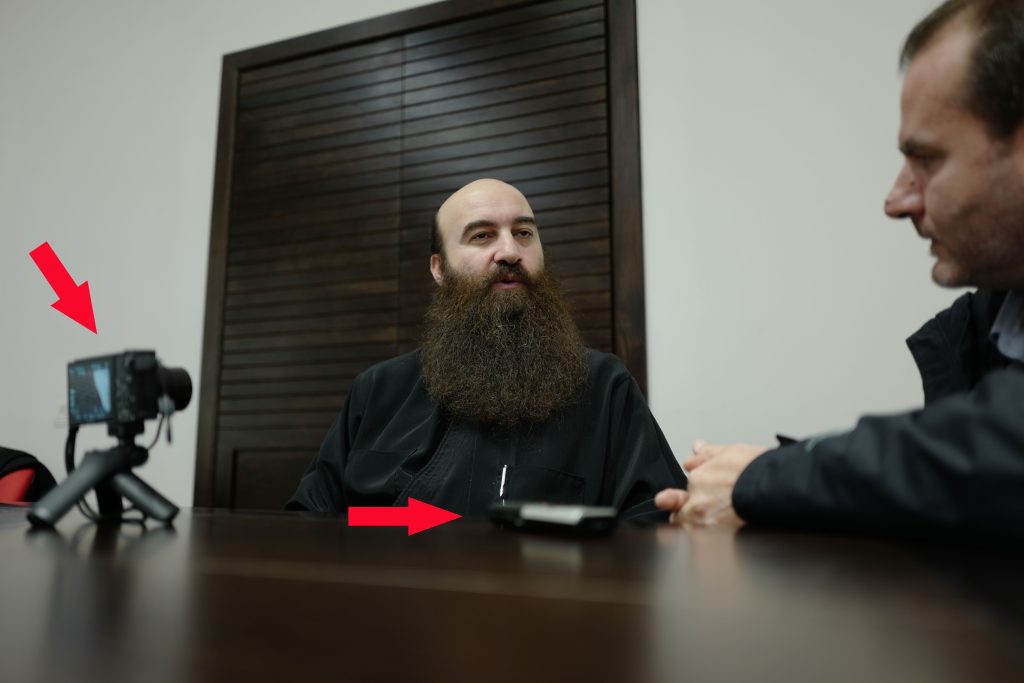
There, without any prior discussion or agreement about what I would ask him or how, I filmed the first testimony documenting how the “miracle of the Holy Fire” is produced.
The moment the revelation was captured on camera
The camera was rolling. The conversation had reached its most critical point. Sitting across from me was the man who, by virtue of his position, entered the Holy Sepulchre before the ceremony and placed the oil lamp inside. Isidoros had already explained how long he remained there. But the decisive question remained: what did he do after placing it?
– How long do you stay inside the Holy Sepulchre?
– About a minute, to leave the oil lamp there.
– And after you place the oil lamp, what do you do?
At this point, he smiled.
– Should we say this on camera?
– If it is the truth, we should say it. Why shouldn’t we?
– I don’t know whether it is right to give this testimony. Because I hold a position of responsibility in the church, I would not want to offend the religious sensibilities of the faithful. I would not want to go into details.
– Then let me ask you this: You go inside and light the oil lamp above the Holy Sepulchre so that the Patriarch finds it lit. Is that so or not?
– That’s right.
– Do you also light the guardians’ oil lamp?
– Yes, there are two oil lamps.
– Do you light that one as well?
– Yes.
The exchange lasted only a few moments, but its significance was historic. For the first time, Isidoros confirmed on camera that, before the Patriarch enters the Holy Sepulchre, he personally lights both the oil lamp he carries inside and places there and the guardians’ oil lamp.
This was no longer merely information, an assessment, or anonymous testimony. The man who performed the act was describing and confirming it in his own words. The oral admission I had heard had now become a historic record captured on camera.
The crucial answer came in just two words:
“That’s right.”
It was a little after 8 when I bid farewell to Isidoros. He headed towards the old city. I, towards… nowhere. The intensity and the burden that the Archbishop of Hierapolis had placed on my shoulders were so great that I must have walked for hours in the – unknown to me – modern city. I had found and documented the truth, but I did not expect that the feeling I would experience would be alien to the words joy, victory, or a “world exclusive” with all that it entails. Yes, the truth had liberated me from the tyranny of a “miracle” or, in simpler terms, a conundrum that violated my logic from my early youth, and furthermore, I saw it influencing and, primarily, fuelling religious fanaticism among millions. An absolute absurdity that bordered on intolerance, alien to Orthodoxy, alien to Christ. Alongside all this, I was thinking of the Hagiotaphites. Not only those who revealed the truth to me, but also those who refused to speak to me when I asked them the simple question: “Is it a miracle?” Even those who “advised” me not to reveal it. All of them.
Fear, habit, insecurity, and even the sense of uniqueness that stems from a “miracle” occurring in the sacred space they serve, are human weaknesses that call for understanding. And they have mine. Those who do not have it are the power-hungry and the professionals of deception. And the line begins with the cunning layman, who sells the “miracle” for financial gain, and extends to the highest echelons of the respective hierarchy, which draws immense power from it, within a framework of arrogance and unrestrained ambition. At the root of all this is falsehood. And in the end, behind all this, lurks insidiously the so-called religious charlatanism. The wound of Christianity and every religion.
All this I pondered during that evening walk. How the Brotherhood would emerge more united and stronger from the ordeal of the revelation, and how it would act as a bulwark against hypocrites and charlatans.
The following morning, I met a good friend who had served as my advisor and guide on my three missions. He was deeply knowledgeable about ecclesiastical matters and the behind-the-scenes workings of the Patriarchate. I told him what had happened the previous day.
He was startled! “You have such material in your hands and you’re still here?” I didn’t understand. “What do you mean? And where should I go?” “You should return to Greece quickly,” he told me. And he continued: “What you have is an atomic bomb, and it’s best they don’t find out you have it until you publish it.”
“And if they find out, what will happen?” “They are capable of anything…” I interrupted him abruptly. “Do not continue. I refuse to accept that people who dedicated their lives to Jesus and to the protection of the Holy Shrines are capable of harming a person.”
He shook his head.
As it turned out, and as we will see later, some were determined to harm me.