
Second mission to Jerusalem: Evidence of the two lit oil lamps
Video evidence shows a flame already burning inside the Holy Sepulchre before the Patriarch enters
On October 22, 2018, I returned to the Holy City. By then, I had documented the basic mechanism by which the Holy Fire is lit, but two objectives remained: to locate the second oil lamp and to record Kornilios’s testimony.
The guardians’ oil lamp was an unexpected development in the investigation. Isidoros had no reason to lie about its existence or the fact that he lit it himself. But who else knew it existed? Logically, it would be the person who placed it inside the Holy Sepulchre on the morning of Holy Saturday. After making inquiries, I learned that this was the senior guardian, Monk Panteleimon.
He was not difficult to find. I met him as he was entering the building that housed the guardians’ cells to rest. I explained what I wanted. “I can’t now. In about two hours, I’ll go back down to the church to officiate. Come and find me in the Katholikon.”
So I did. I sat in a corner of the courtyard and waited for the two hours to pass. Observing the crowd, I noticed that compared to my previous visit, there were many more people. It was difficult to pass through the enormous central gate. As for the wait to enter the Holy Sepulchre and venerate, it was many hours. My own wait passed quickly and pleasantly, as I was observing people. After the central gate, the first venerated object every pilgrim encounters is the Stone of Anointing. There, one kneels, kisses the marble, and many spread personal items, such as clothes, to receive a blessing from myrrh or blood that miraculously emerges, as we read on various religious websites. Let’s see an example in a video where a believer there announces the “miracle” at the moment when “the stone was flooded with myrrh”.
I approached. Indeed, a liquid with a pleasant scent was evident everywhere. I took out my camera and photographed what I saw.
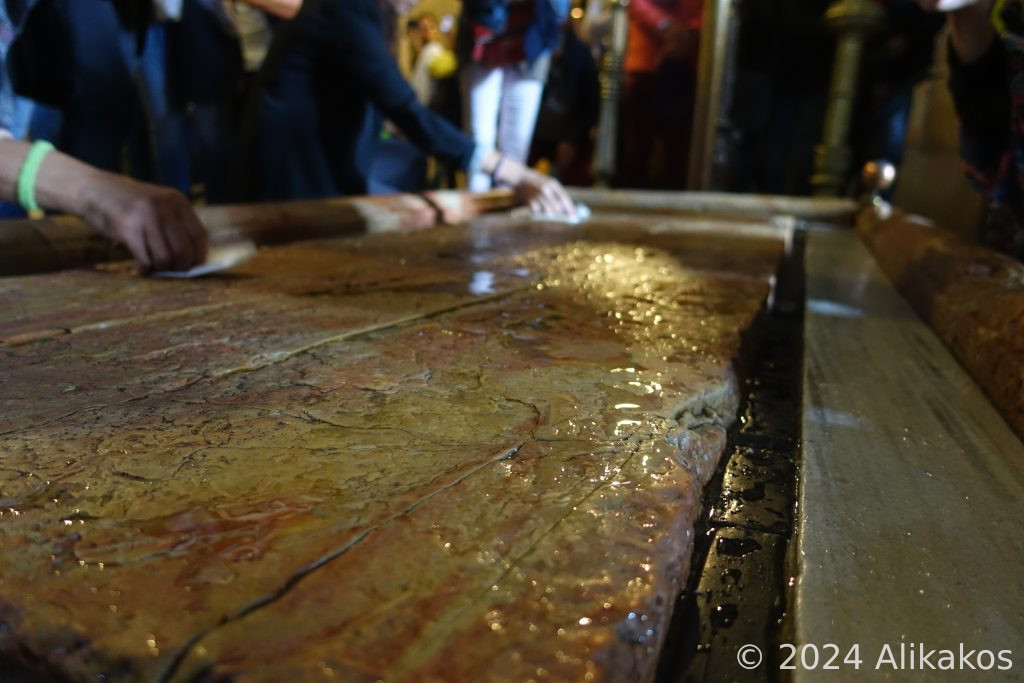
How did this liquid get there? Where does it come from? Who pours it? My question was answered a little later by the person I was waiting to meet. We will see the solution to the… mystery.
Now it was time for the meeting about the second lamp. I had to learn everything about it.
“I’m the one who places the guardians’ oil lamp”
Around 2 PM, I went to the Katholikon. I saw Panteleimon at the chanter’s stand, along with a deacon, chanting. I sat next to him – keeping the ‘ison’ (drone) – and remembered the Byzantine music I learned as a young man. “We’ll be done in ten minutes,” he whispered to me.
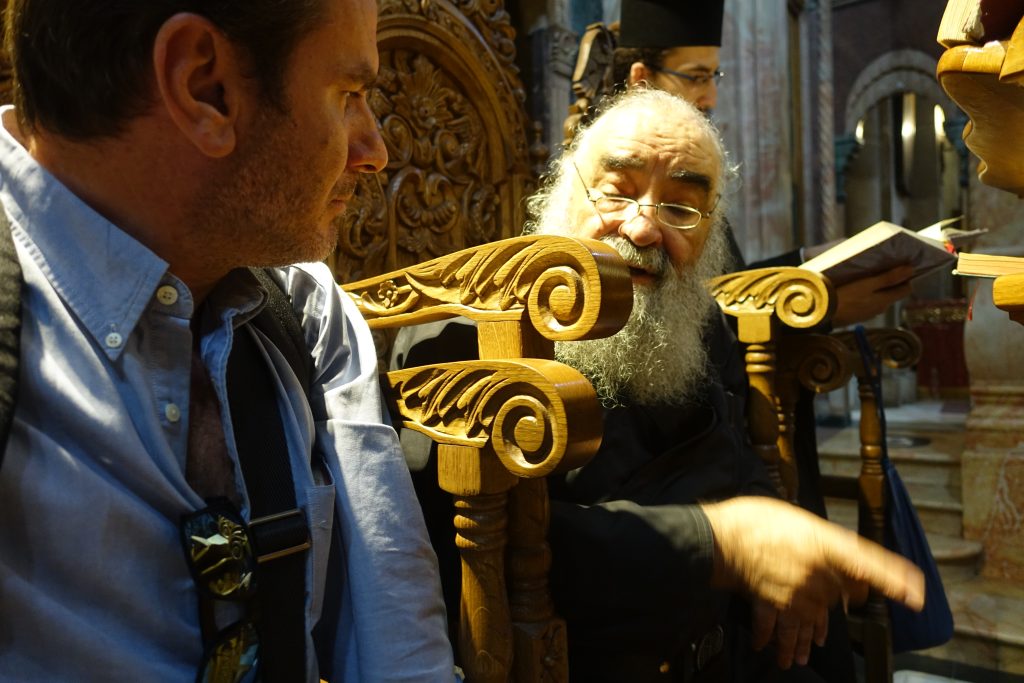
Indeed, ten minutes later, I was following him as he crossed the church, heading towards a small storage room for the guardians. We went inside; he took a ladder and climbed up to open a cupboard. He brought down the lamp, and holding it, he began to speak to me. I recorded his testimony on video. We will see it.
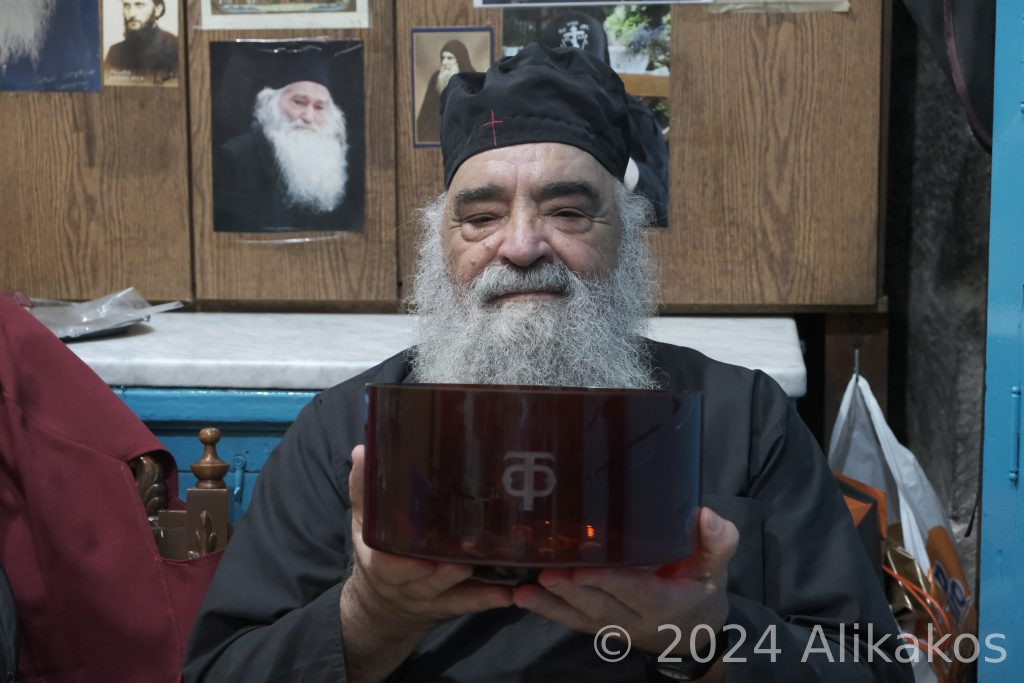
“This is the Holy Fire guardians’ oil lamp. It bears the initials ‘ΦΤ,’ which stand for Fýlakes Táfou (‘Guardians of the Tomb’). We place it unlit inside the Holy Sepulchre at 8:30 on the morning of Holy Saturday.” “Since 1992, I have been the one who places the guardians’ oil lamp, as the senior guardian. I place it to the left of the Tomb.” “In the middle is the booklet containing the Prayer, and beside it is the sacristan’s oil lamp, which is placed there later.”
The existence of the two lamps is also confirmed by Archimandrite Father Matthaios, who in recent years has served as dragoman and is the first to enter the Holy Sepulchre after the Holy Light ceremony. He told me: “When I enter the Holy Sepulchre, I see two lit lamps.”
And yet, for all the above, there is also visual evidence. In 2018, on Easter Sunday, a video was uploaded to YouTube through the account of an Armenian priest. In it, someone is seen entering the Holy Sepulchre, just a few seconds after the Holy Light ceremony, and recording with his camera everything that is on the Sepulchre.
In the first frame, we see the dragoman Archimandrite Father Matthaios removing the lit ever-burning lamp that the skeuophylax had lit.
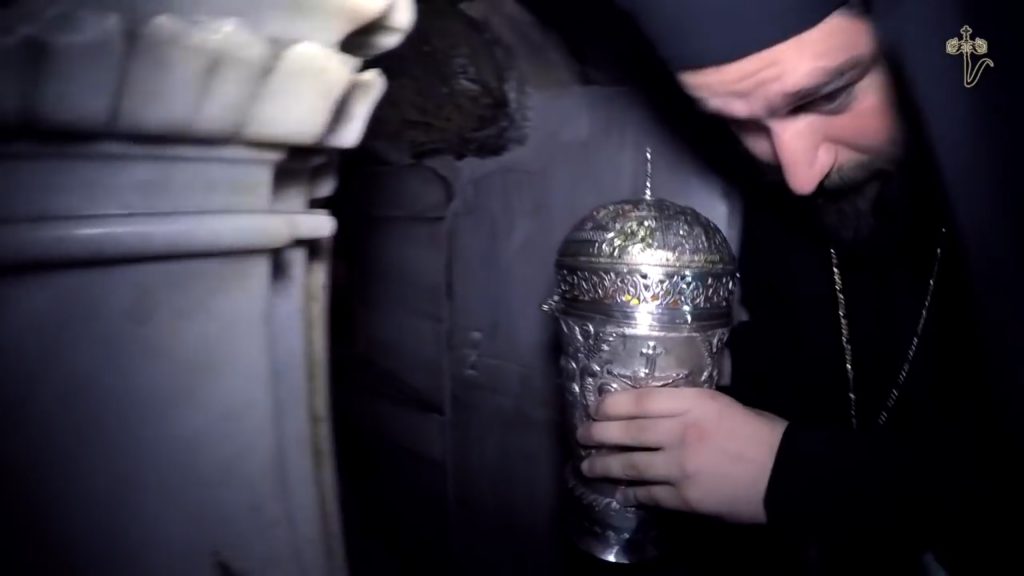
Subsequently, the cameraman enters the Holy Sepulchre. The next still is the most important and constitutes a historical record. In the middle, the leaflet with the Prayer is clearly visible, to the left is the lit lamp of the guardians, again from the skeuophylax’s lighter, and next to it is a small candle – we will explain its purpose later.
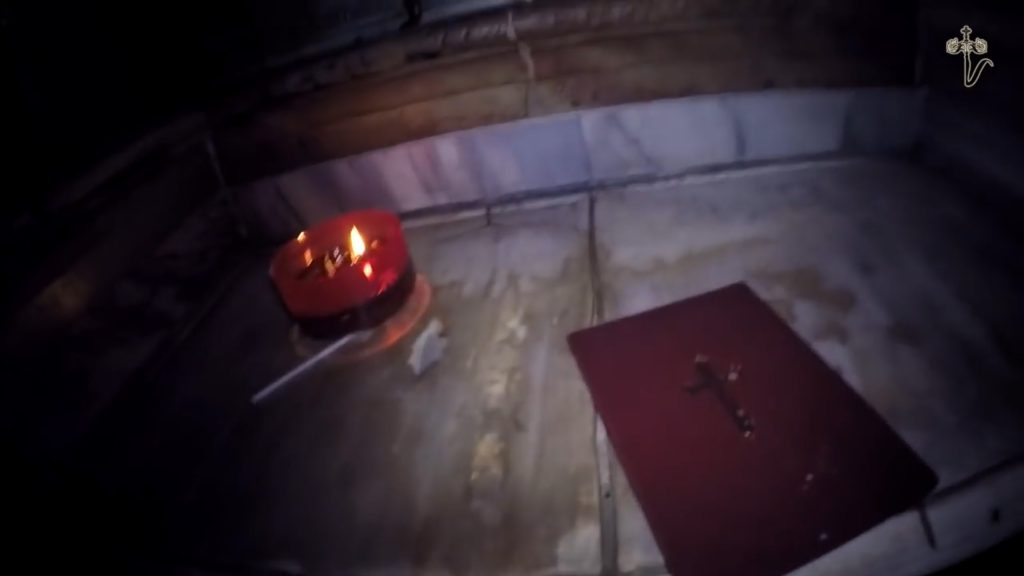
Immediately after, a Greek Orthodox monk steps in front of the camera, forbidding the Armenian from continuing the video recording.
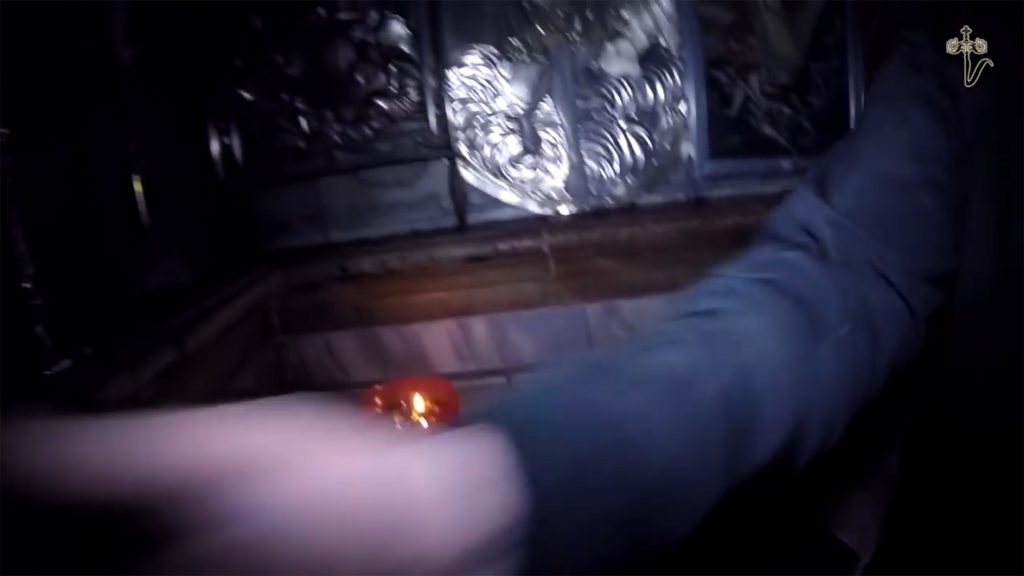
Finally, the senior guardian, Panteleimon, removes the lamp that he himself had placed on the morning of Holy Saturday.
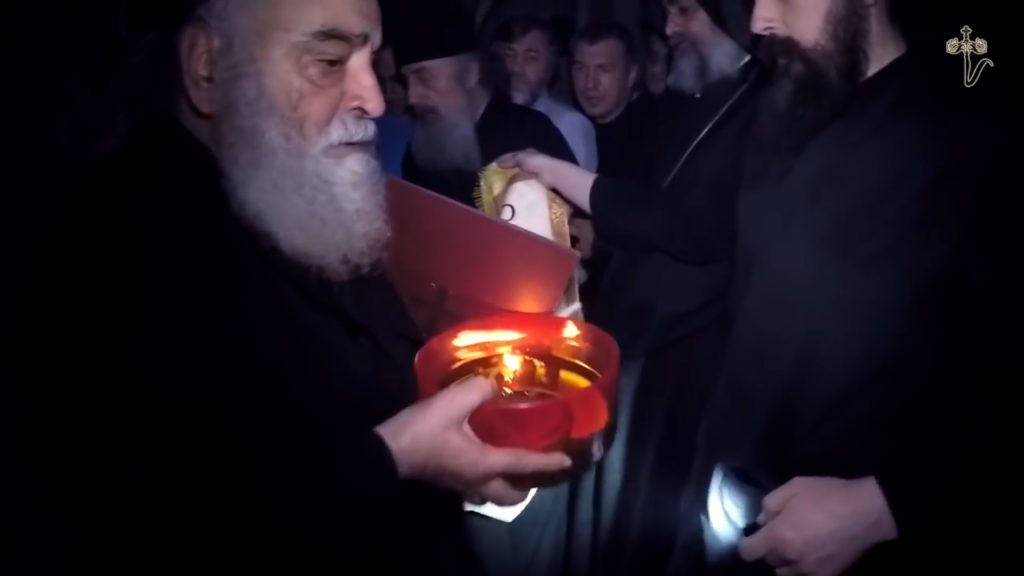
Let’s also see a rare video from the 2009 ceremony, where both lamps are visible together.
The images we have seen provide conclusive confirmation of the evidence presented so far, as well as the evidence that follows. The reader should note the following: the absolute documentation of the existence of two lamps inside the Holy Sepulchre, which have been lit, as we will see later, by human hand before the Patriarch’s entry.
We will see all of this in video as well. But now it’s time for the most important video ever recorded on Holy Saturday during the Holy Light ceremony.
Revelation Video
A few months after Easter 2021, on October 16, a video appeared on the YouTube account of the same Armenian priest that went almost unnoticed. One of the reasons – besides the title being in Armenian – was that the title spoke of a miracle, yet the video showed no miracle. As the priest later explained to me, he did not want to give it the character of a revelation, but by writing in the title “Proof of a miracle exists! Holy Light” it was “a form of irony”. Few understood it.
I immediately requested the original file, exactly as it came from the recording camera (which, as it turned out, was an iPhone 11). He sent it to me. After careful examination, I confirmed that it had not undergone the slightest alteration.
The video showed something we were seeing for the first time: what is on the Holy Sepulchre at the moment the Patriarch and the Armenian priest enter. Out of the 27 seconds of the video, there were 2 critical seconds that showed there was already a flame inside the Sepulchre.
In February 2022, I brought together the following material:
- a) the testimony of guardian Panteleimon that I had videotaped,
- b) footage of the lamp’s entry in 2020 when due to the pandemic the church was empty of faithful,
- c) the revelation video that showed the Holy Sepulchre before the Patriarch and the Armenian priest entered, and
- d) the video that showed what was on the Holy Sepulchre after the ceremony.
I combined these videos into a single video, which proved beyond any doubt that there is a source of fire inside the Holy Sepulchre before the Patriarch enters. Watch it.
After this video, what was still missing to conclusively prove that Isidoros lit the lamps was his own testimony, but this time recorded on video. We will see it shortly.
Before we conclude this chapter, let’s look at the solution to the mystery of the “miracle of myrrh”.
Myrrh. The solution to the mystery.
The answer to the questions “How did this liquid get there? Where does it come from? Who pours it?” is simple. Panteleimon himself gave it to me, as did a report from a foreign television channel. Watch it.
The Patriarchate’s Response Regarding the Falsified Text of the Prayer
After returning to Greece from my first trip to Jerusalem, I conducted further research and confirmed that the five words we discussed had indeed been missing from the Prayer of the Holy Fire for at least nine years. I informed the Chief Secretary and requested an explanation. On October 23, 2018, I recorded the Patriarchate’s official position, as stated by Aristarchos: “The official position of the Jerusalem Patriarchate on the Holy Fire is the one set out in the programme of the Holy Fire ceremony held each year on Holy Saturday; on the Patriarchate’s website concerning each year’s ceremony; in the studies of distinguished Holy Sepulchre Fathers, particularly that of the late Kallistos Miliaras1 in the journal Nea Sion; and in whatever may be inferred about the Holy Fire from Holy Scripture and the Fathers of the Church. Whatever no longer appears on the Patriarchate’s website, we do not endorse.”
Aristarchos did not accept any further questions on the matter. It was evident that he did not want to pursue it further. Therefore, we will never know not only who falsified the text, but also why the Patriarchate did not react – if it knew – all these years. We retain the Patriarchate’s last statement: “We do not endorse the mention of the miracle” – because that is essentially what it said, as, among other things, this word – miracle – was removed from its official website.
- It should be noted that Miliaras, in his “Description of the Contemporary Ceremony of the Holy Fire” (pp. 24–34), makes no mention of a miracle. He writes: “After the prayer, the Patriarch reverently venerates the Holy Sepulchre and receives the Holy Fire…” ↩︎