
The Court Testimony of the Jerusalem Patriarchate’s Chief Secretary
“How is the Holy Fire lit?”
“I do not answer. I invoke the confidentiality…”
On 10/25/2025, we were provided with the trial transcripts that were issued on 10/04/2024.
(Note: This is a recording that was automatically converted to text by special software by the court secretariat. This is why in some parts of the minutes it was not possible to capture words or phrases. The responsibility for correcting errors or omissions from the transcription was, where possible, held by lawyer Ath. Anagnostopoulos)
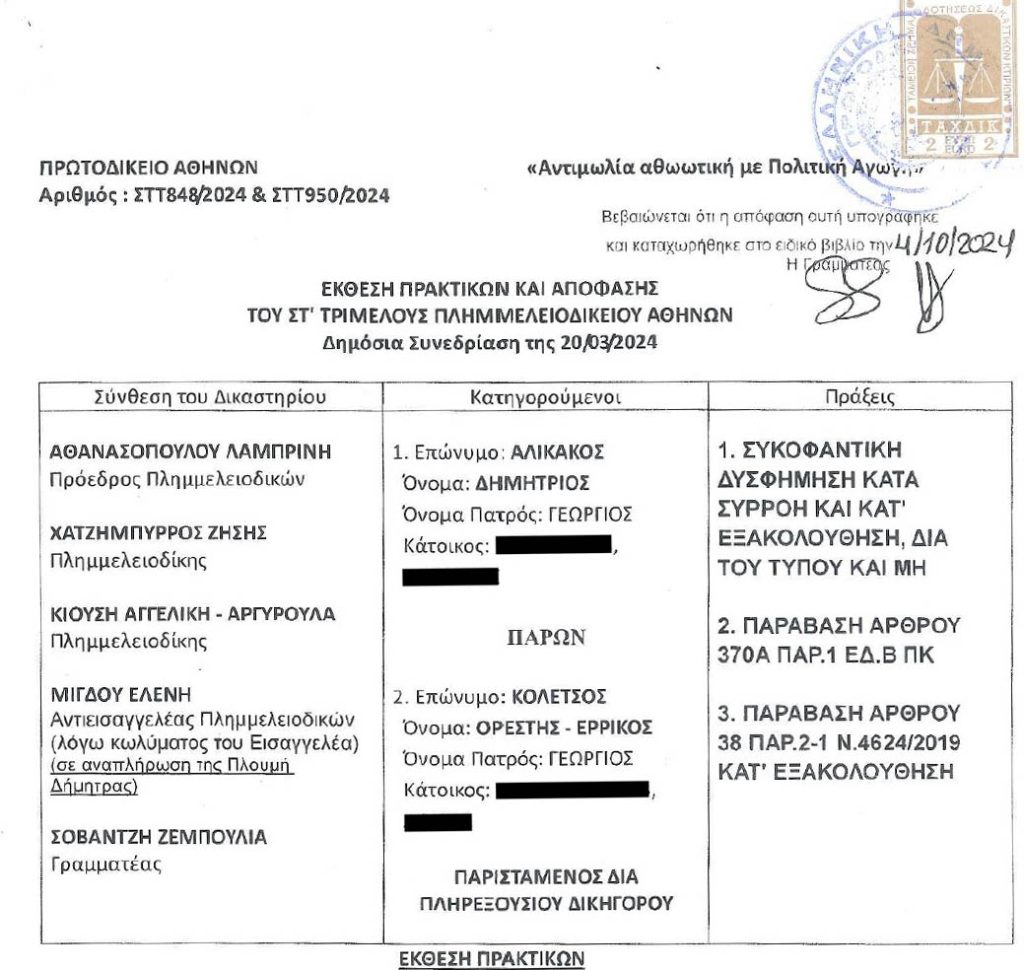
I present the historic deposition of the Holy Sepulchre Archbishop Mr. Aristarchos, Chief Secretary of the Patriarchate of Jerusalem, as it was recorded in the minutes. This is a highly revealing document:
Commencement of Testimony.
– (Court President) Please tell us. Are you there? If it’s not clear, would you like us to bring the microphone closer?
– No, let me try.
– Can you hear us?
– Yes, I can hear you. Can you hear me?
– Some things were written here in a book about some… Discussions you had with… Let’s say the first one, with Dimitrios Alikakos. Are you an archbishop?
– Yes, I was. [I am]
– Of the Patriarchate of Jerusalem?
– Yes.
– Please tell us. Were there any discussions initially? Had he come as a journalist to investigate this matter?
– Mr. Alikakos called me, perhaps in 2017 or 2018, and told me that he was a pilgrim and that, as a pilgrim, he was interested in learning from me about the Patriarchate of Jerusalem, about the life of the Patriarchate of Jerusalem, about its problems, about the Holy Fire, and that anything we discussed would be treated confidentially, as a confession, as the prosecutorial document also states, and he asked us to keep it that way. I was surprised by the call, but I responded to his inquiries and helped him. I spoke with him. In fact, despite not having much time, I generously dedicated time to him. When he asked to come to Jerusalem, I facilitated his access, introduced him to His Beatitude Patriarch Theophilos, to the elder sacristan, His Eminence Isidoros, to the late Metropolitan Cornelius of Petra, and I accepted our entire relationship as one between a penitent and a confessor, and I maintained this relationship and received him as a pilgrim and guided him, just as I have guided many other pilgrims over the sixty years I have been at the Patriarchate. Subsequently, when Mr. Alikakos published his controversial book, I realized that he had concealed his identity as a journalist from me, presenting himself as a pilgrim, and I believe and state that his method was one of deceit and fraud, and this is evident from his book because he himself says that he recorded me and meticulously kept track of the times, the durations of our discussions and conversations, even down to minutes and seconds, as he states in his book. There I realized that he was not consistent with what we had said from the very beginning. Whatever transpired between us, transpired within the framework of the sacrament of confession; that is how it was presented, that is how he requested it, that is how I saw it, and that is how I uphold it. The sacrament of confession has the…
– But confession between whom? That is, was he confessing to you?
– What we said was confessional. He himself, yes.
– From his side or from your side?
– Both from my side and from his side. And I uphold that. And if at this moment he asks me to take a stand on the book against him, I say that I will not take a stand, because I am prevented by the sacrament of confession, the confidentiality of the sacrament of confession. Because people, pilgrims who in the past and now confessed or did not confess to me, depending on my answer, will either maintain the trust they have in me or their trust will be shaken. That is, he created—and this is the primary accusation, it has priority, from my perspective—that he violated and harmed the sacrament of confession. And my image in Greece and internationally as a negative image that he created. Primarily, I state and say that he (UNCLEAR RECORDING – possible word: violated) the sacrament of confession, and secondarily, he violated me, His Beatitude the Patriarch, His Eminence Isidoros, and the Patriarchate, and the ceremony of the Holy Fire, in addition.
– Let me ask something. Did he tell you that he was videotaping these things you are saying? That he was audiotaping these things?
– No, he did not tell me.
– He didn’t tell you?
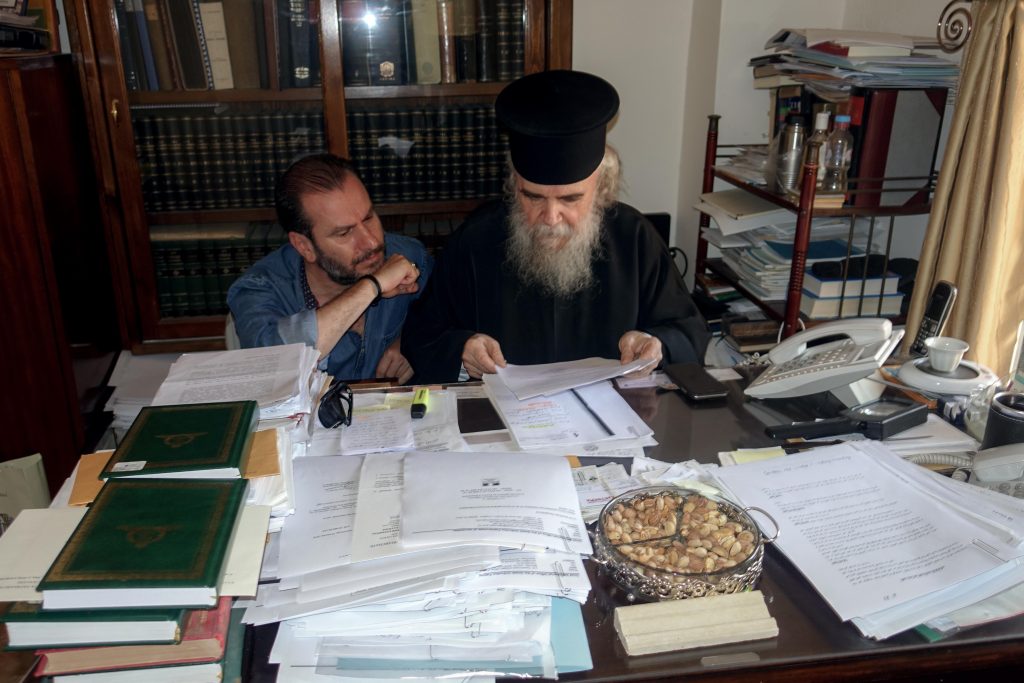
– No, he did not tell me. He did not tell me. I discovered this from his book afterwards and I protest against it. I also protest the fact that I do not remember if it was with my knowledge or without my knowledge that he photographed me in my office, and there he used my photograph and placed it without my permission in his defamatory book about me. This book presents my image defamingly in Greece, whereas my image is positive both in Greece and internationally due to my sixty years of service at the Patriarchate. And, I believe, due to my stance and position in life. These are what I would like to say about Mr. Alikakos. I am very sorry. He greatly saddened all of us. Both the Patriarch and His Eminence Isidoros and myself. And we demand that the sanctions and penances provided by the rules of the church for his violation of the sacrament of confession be applied. I speak as a Bishop regarding Mr. Alikakos. And we demand that he retract his writings in the book for the restoration of the Patriarchate, for the restoration of the life of the Patriarchate, of the ceremony of the Holy Fire, and of us personally.
– Here he wrote [in the book] some things that you told him that the oil lamp remains lit in the Holy Sepulchre. Did he write this here as a fact in the book?
– Yes.
– Did you say that?
– No. I state the following again. That I do not speak on this matter. I do not take a stand on this. Because I also include this under the confidentiality of the sacrament of confession.
– Yes, but here (UNCLEAR RECORDING – possible words: this is a court) he is not here for the matter of confession. He is here as a defendant for the offense of slanderous defamation. And we need to see if this was actually said or not.
– I tell you that I do not take a stand on this, even if it is negative against me, because I am a Bishop, I am a confessor, and I uphold the confidentiality of the sacrament of confession. That is, whatever transpired between us, I include it within the framework that was established between us. This relationship was established between us, which I tell you was a friendly relationship, a human relationship, a social relationship, and a relationship between a Bishop and a pilgrim.
– But now, since you are the complainant, that is, you have filed a complaint, the matter is no longer between you and him regarding confession; it has taken on criminal dimensions.
– Alright.
– You are in a courtroom. The other person, the one you accused, is the defendant. And the court is asking you again. You must state some things, whether these events that transpired are true or not, for it to form a judgment.
– Yes. Well, I told you, I answered you. This is my answer again. That I cannot testify about what was said between us confessionally. Because I violate the sacrament, the confidentiality of the sacrament of confession in this way.
– So your position is that you said some things which may or may not have been said, but they are at the level of confession…
– And I cannot testify. I cannot testify whether they were said or not. Because this shakes the trust of the many people who have confessed to me over time, and others even today. And I do not wish to.
– Here, the indictment does not concern the matter of violating confession. That might be another matter, pertaining to religious issues. Here we are a criminal court.
– Alright. I see it that way, Madam President.
– I understand, I comprehend. But I am also explaining to you now how things stand.
– Yes. I cannot say anything more because there is the confidentiality of confession which prevents any spiritual father from speaking.
– Madam Prosecutor.
Questions from the Prosecutor.
– (Prosecutor) Let me ask something. Did you know that he had come, and you mentioned in your complaint, as I see it now on page 4, that in any case, he had visited you primarily in the capacity of a believer and secondarily in the capacity of a journalist.
– Yes.
– Therefore, it is mentioned in the complaint you have filed.
– Yes.
– Therefore, did you know that at the time of his visit and at the time he sought to communicate with both you and the second aggrieved party, he was conducting a journalistic investigation regarding the Holy Fire? Did you know this?
– No. I knew that he was conducting this research in his capacity as a pilgrim. And I responded to his needs and concerns and accompanied him on this journey. If he did not appreciate it, that is his own matter.
– However, it seems that he managed to converse with you and the second aggrieved party during his visit. Is this something all pilgrims do? That is, is access so easy? Do all pilgrims, after all, have such easy access to resolving their internal inquiries or all of these matters?
– Depending on our duties. Depending on our capabilities. Because the work of the Patriarchate is multifaceted and diverse, as is my ministry as Chief Secretary and His Eminence Isidoros’s as Sacristan. But I tell you that I created access for Mr. Alikakos, I treated him kindly, as a pilgrim, and yet he subsequently, I apologize, showed a different face, while we hosted him like nobles, I believe he did not show the required greek philotimo and did not even thank us. We received defamation, irony, and mockery.
– Yes. Regarding the second (UNCLEAR RECORDING – possible word: appellant→Isidoros). Do you know if he himself had given him permission to record any conversation or to shoot any video? Or anything? Do you know anything about this matter?
– No, I introduced Mr. Alikakos to the sacristan. And I told him that a pilgrim was coming, to respond, receive him, explain to him. And generally about the Church of the Resurrection and the Holy Fire. And after the discussions they had in the church, they also went to the Notre Dame hotel, and there I recently learned from His Eminence Isidoros that he caught him by surprise there because he had set up a camera lens and caught him off guard and started asking him questions. And he [Isidoros] told him that he did not want to, and he [Alikakos] said that he would not publish them. And then he [Alikakos] told him that he would publish them, not to worry. And he [Isidoros] expressed his refusal to this, and Mr. Alikakos disagreed and argued, and they left it at that. This is what I know from His Eminence Isidoros.
– Yes. Let me ask one last thing. It appears that some photographs of yours (I refer to the plural) had also been published in the book. How did these photographs come into the defendant’s possession? Had you exchanged any emails? Had you sent any photographs? And if so, for what reason?
– He has one photograph of me in his book.
– Yes, that. How did it end up in the book?
– He came, well, since he came and I received him in my office. And I received him in my room despite my obligations.
– I don’t understand. He came to your office and you received him, and how? Did he photograph you? Or did you send him the photograph?
– No, he photographed me. He sat in my office and there I made my final statement to him when he asked me what the ceremony of the Holy Fire means to you for the Patriarchate. And I told him what I am also testifying here in five lines. And there he photographed me but did not ask for my permission to place my photograph in his defamatory book.
– What did he tell you he would do with the photograph? Did he tell you for what reason?
– No, I think he told me it was a commemorative photograph. We took a commemorative photograph.
– Was he also in the photograph?
– No. He was sitting on this side and I on that side in my office.
– Yes. You said that the last question he asked you in the context of these meetings was what the ceremony of the Holy Fire means to the Patriarchate.
– Yes.
– Do average pilgrims ask such questions? This somewhat resembles the framework of another type of investigation. That is, I mean, are all the pilgrims who come…?
– Many times.
– Is it easy for any pilgrim, after all, to be able to come to your office?
– Yes, it is easy. We have a different way at the Patriarchate of Jerusalem, and the hierarchs, and even the Patriarch himself, receive pilgrims, speak to them, explain things to them. They approach him, kiss his hand. And us. That is, it is not like in Greece or other countries where you have to make a special application to see a metropolitan or the patriarch in other countries. No. The way of life in Jerusalem is different, and that is how I received Mr. Alikakos.
– Indeed. I have no further questions, Madam President.
– From the bench? Come forward.
Questions from the counsel for the prosecution.
– Your Eminence.
– Yes.
– Can you tell us if the defendant invoked any status regarding his education? Or his family that led you to gain greater trust in him compared to the average pilgrim?
– As far as I remember, he must have told me that his father is a priest’s son and that he graduated from the Rizareios School, as far as I remember.
– Let me ask something, in the Greek territory, the Brotherhood of the Holy Sepulchre…
– May I drink some water?
– Yes.
– Yes, thank you.
– How many members does the Brotherhood of the Holy Sepulchre have?
– Let’s say we are about 100.
– In the Greek territory, are you widely known, does the general public know you, to put it more simply?
– I think they know us because of the media, the Mass Media, and even more so because, apart from the COVID period and apart from the current war period, there are many pilgrims who come. And their center, look, their center is indeed the Holy Sepulchre, it is the Church of the Resurrection, because the Church of the Resurrection is the place of the crucifixion and resurrection of Christ, and there is the event of events of Christianity and history. But always during their pilgrimage to the holy sites, the focal point of which is the Church of the Resurrection and the Tomb of Christ and Golgotha, they always have, especially with the current Patriarch, a visit to the Patriarchate; that is, it is considered indispensable to come to the Patriarchate.
– Your Eminence, I am not talking about the Patriarch, but about the members, like yourself. You hold the title of Metropolitan.
– Of Archbishop,
– Of Archbishop, is it comparable to the title of Metropolitan held by a member of the Church of Greece, a Public Law Legal Entity of the Church?
– No, because we are a brotherhood, we are the Brotherhood of the Holy Sepulchre. Our Patriarch is the fifth Patriarch in the order of Patriarchates, but he is also the abbot of the brotherhood; the Patriarch is the abbot of the brotherhood. Since the 4th century, we have constituted a monastery. Therefore, we do not have the independence that the Metropolitans of the Church of Greece have in their statements to do something, to announce something, or even to decide something; we must obtain permission from the Patriarch, in a universal sense, so to speak.
– Your Eminence, you had some telephone communications with the defendant from Greece; you yourself had some communications. Obviously, for him to come at some point, and you speak with many people, as you said anyway, your phone number or the Patriarchate’s phone numbers are not a secret. Had he informed you that he was recording these conversations?
– No.
– No. Because you also found that the book meticulously records durations, dates, and all of that.
– That is why I attributed deceit to his method; he ought to have informed me, do you understand? That is why, no, no, he had not informed me.
– You said he came as a pilgrim; every pilgrim also has a status, a profession,
– Yes, correct.
– Right, right. So, even if you knew he was simply a journalist, that doesn’t mean you knew he came specifically to investigate something. Everyone has a profession.
– I told you that from the very beginning, I accepted him as a pilgrim.
– Alright.
– An atmosphere of a pilgrim and a Holy Sepulchre bishop was established between us.
– Especially since he was a priest’s son, something he emphasized.
– Indeed.
– And it also elicited your positive…
– Indeed, indeed, and I regret that he dealt with things as he writes them in his book and did not see them from another perspective, both as a Greek and an Orthodox Christian, because I believe that in his way, he offends Hellenism and Orthodoxy. The Patriarchate represents Hellenism in the Holy Land, and the Patriarchate is the glory of Hellenism in the Holy Land.
– Alright, okay. Indeed, you stated that regarding the photograph in the book, you never gave your consent for that photograph to…
– He never asked me for it to place it in his book.
– Alright. Are there also some photographs of Archbishop Isidoros?
– Yes, I told you.
– Did Isidoros give consent for the photographs to be published in a book?
– No.
– How do you know that? Have you confirmed it?
– I know it from Isidoros, I know it from Isidoros.
– Alright, you said he appeared as a faithful person with spiritual quests.
– Correct.
– So the conversations that took place with you and other members of the Holy Sepulchre Brotherhood were broadly about spiritual matters, as I understand from what you said.
– Correct.
– Is that so?
– Correct.
– A question arises, and I must ask you why it is stated. We are talking about the Holy Fire ceremony.
– Yes.
– And he himself emphasizes and says that in the past we spoke of a miracle, and subsequently, on the Patriarchate’s website, you speak of a ceremony.
– Yes.
– Please explain a little what ‘ceremony’ means, what is the broader meaning of the ceremony? And why was it phrased this way? And what does this ceremony generally include on that day?
– Look, I told you, I have told him that in the Patriarchate’s Holy Week ceremonies program, on Holy Saturday, it is written—and I have it here somewhere to give you to submit to the court, I have it here, I will take it out later—it says “Ceremony of the Holy Fire.” I believe that within the word ‘ceremony,’ the word ‘miracle’ is implicitly included. When, for example, we speak of the ceremony of Holy Oil, of Holy Unction, will you ask me if it’s a miracle? I will tell you, the miracle is included within the ceremony; what will you tell me about that? When we speak of the ceremony of Sanctification, of the Small Sanctification or the Great Sanctification, and you ask me if it’s a miracle? Well, what will I answer to that? The word ‘ceremony’ says it all, and we don’t need to investigate; “ἐξέλιπον ἐξερευνῶντες ἐξερευνήσεις,” says the Psalter. [Author’s note: This phrase is particularly interesting and means “They were exhausted studying their machinations.” For the interpretive rendering by theologian Ioannis Th. Kolitsaras and the context of the phrase, see here] And regarding the ceremony, the one you mentioned, this is one of the very important, grand, solemn, and magnificent ceremonies of the Patriarchate of Jerusalem on Holy Saturday. And let me mention here in court, if you mean that on Holy Saturday, approximately 12,000 pilgrims flood the Church of the Holy Sepulchre, and another 12,000 are in the streets of Jerusalem, waiting from 5:00 AM until 1:00 PM when the Holy Fire ceremony ends, struggling and clashing with the police to enter the Church of the Holy Sepulchre, even just to say they entered the Church of the Holy Sepulchre. And for this ceremony, representatives of our churches, foreign churches, representatives of states request and come; even Israelis struggle for a place. One balcony, one from the Edicule of the Holy Sepulchre, is for the Israelis; another balcony is for the Greek consular and diplomatic officials who come.
– (Presiding Judge) Alright, you asked. Will you ask anything else?
– Yes, I would like you to tell me a little, what is the impact now of all that has been recorded, both on you in your daily life, and especially on His Eminence Isidoros.
– The impact is that a negative image was created for us, both for myself and for His Eminence Isidoros. We are not known in the way Mr. Alikakos presents us, and I believe, alright, we are sinners, but neither I nor His Eminence Isidoros are worthy of such a presentation and insult in Mr. Alikakos’s book.
– So, to conclude, do you believe that the accused deceived you, misled you?
– I believe he misled us by presenting and projecting himself as a pilgrim and not as a journalist, who, it seems, had from the outset the intention to deal with the Patriarchate’s issue in the way he did. Yes, that is what I believe, and that is what I testify in court.
– I have no further questions.
– Very well, you will be questioned by the other side. Please proceed.
Questions from defense counsel.
– Mr. Complainant, you have been at the Holy Sepulchre in its service since you were a child, I believe?
– Yes.
– So, for many decades, you know people and things in detail. I presume you have lived through many patriarchs.
– Alright, okay.
– Do you know the absent complainant, His Eminence Isidoros?
– Yes, I know him, my student, he was my student.
– Your student? He was your student.
– Yes.
– Why didn’t Isidoros come today?
– Isidoros had a problem with his visa.
– Ah, he had a problem with his visa…
– Yes, that’s why.
– It was the fourth time he had a problem, okay.
– (Prosecution lawyer) If you allow me, there are documents, if you deem it appropriate, to be submitted. The visa expired on March 11; he applied for renewal and was given an appointment for April 6. I can submit them simply to resolve any dispute regarding his absence. He wanted and had planned to be here, and the ticket that was issued exists.
Oh, how convenient, what a pity. Mr. Complainant, I did not understand…
– (Prosecution lawyer) It is here if you wish, to justify the absence so that no misunderstandings arise. It is the appointment as given by the Ministry of Interior.
– I did not understand from your testimony which part of the book you consider to be defamatory towards you. I am not asking you to tell this esteemed court something from the confession, but from the book that everyone reads. Which part of the book is defamatory to your person, that is, to you?
– I told you that in the…[book] he presents us in a very negative light. That we hide the truth from the world, we do not inform the world, and then I told you that I am not willing, due to the confidentiality of confession, to tell you more, even in court, as another answer to this first.
– Let’s ask a little about that. About the sacrament of confession. I was under the impression that the sacrament of confession means I go to my spiritual father and confess my sins. Did Mr. Alikakos confess his sins to you? Is that why he went to the Holy Sepulchre?
– No, it’s not just that. It’s not, it can…
– What else? Tell me.
– You can go to a spiritual father, but you can also confess. There are times when pilgrims or others confess to us today; they confess by phone. And when the appropriate opportunity arises, we read the prayer. He put it this way, that he wanted to confidentially confess his concerns to me about problems of the Patriarchate and especially about the Holy Fire service.
– So he confessed to you his research interest to learn how the Holy Fire ceremony takes place?
– Yes, that too, yes.
– And is that covered by the confidentiality of confession?
– Yes, yes.
– Indeed, it is clear. So tell us a little how it happens? First of all, in the Holy Fire ceremony, who participates from the hundred-member brotherhood? Do 20, 50 participate? Who participates?
– As many as are… Look, most of those who are not hindered by their duties come, but most come, even from the distant desert monasteries, in order to receive the Holy Fire from the Holy Sepulchre and be sanctified.
– Perhaps I did not clarify. When I say ‘participate,’ who participates actively? The Patriarch, I presume. Is there anyone else who actively participates in the ceremony?
– Certainly.
– Who is that?
– Actively participating in the ceremony are those in the procession that takes place, because a procession takes place.
– Not in the procession, not in the procession.
– Excuse me, there is also a ritual.
– Please, please.
– And the ritual is that this ceremony is the Vespers of Holy Saturday; we chant ‘Joyful Light.’ And there, many priests, including those from our own church, vest because they must participate in the ceremony, and that is why it is also a ‘parrhesia’ for us. What does ‘parrhesia’ mean? It means our presence/representation to the other denominations with whom we coexist in the Church of the Holy Sepulchre, and there are times when the crowd is so great that we do not accept everyone from the other churches who come. Because they come from other churches, from the Patriarchate of Moscow, from the Patriarchate of Romania, and a large crowd gathers.
– I understand. May I ask…
– Therefore, many participate.
– Let me ask even more specifically. Who enters inside the Holy Sepulchre? How many enter?
– Inside the Holy Sepulchre, the Patriarch enters.
– The Patriarch. Does anyone else enter before the Patriarch?
– Pardon?
– Does anyone else enter before the Patriarch?
– I do not know these things because I do not have that responsibility.
– You do not know them.
– Excuse me, I am the secretary of the Patriarchate. On that day, I am next to the Patriarch to receive the Greek delegation and other representatives who come, and to descend with the Patriarch to the Church of the Holy Sepulchre and before the Holy Sepulchre, and I know nothing inside the Holy Sepulchre.
– Do you perhaps know, or have you heard from Isidoros, who is your student?
– Yes, yes.
– And what position does he hold now, Mr. Complainant?
– Excuse me, if I know what?
– What position does Isidoros hold now?
– He is the Skeuophylax.
– Is he the Skeuophylax of the Holy Sepulchre?
– Yes.
– So, from your personal relationship, Isidoros’s apprenticeship with you, and his position, do you perhaps know if the Skeuophylax enters the Holy Sepulchre before the Patriarch?
– No, I did not ask him, I have not asked him, and I do not know.
– You do not know?
– No, I do not know.
– Do you perhaps know if Isidoros introduces a lamp into the Holy Sepulchre before the Patriarch enters?
– No, I do not know.
– Is this the first time you hear this?
– I do not know. Isidoros…
– Did you read Mr. Alikakos’s book?
– Yes, I read it, yes.
– Since you read it, did you not ask Isidoros, ‘Brother, what does it say here about you? It says that you introduce a lamp into the Holy Sepulchre, and there are also photos of you ritually holding it and entering the Holy Sepulchre.’ This is the first time in my life I hear this, is it true? Did you not ask him?
– Look, our relationships, I told you, are like brothers among us, and we speak to each other as brothers. Okay? And regarding what you are asking me, I discussed it with him, with His Eminence Isidoros. He told me his opinion and his position, and I have stated it, I have testified it.
– So what did Isidoros tell you?
– Pardon?
– What did Isidoros tell you about this exact issue, of the lighting, what did he tell you?
– He did not tell me about the issue of the lighting, he did not tell me, no.
– Just now you said that you asked him and he told you his opinion.
– No, I thought he told me his opinion regarding the photographs Mr. Alikakos took of him.
– Only regarding the photographs?
– Yes, yes.
Very well. Therefore, are you unaware if there is a lamp in the Holy Sepulchre when the Patriarch is already entering? You don’t know that?
– Look, I told you, I told you…
– Is this the first time you hear it?
– No, I am not hearing it for the first time.
– You are not hearing it for the first time? So you know something?
– I am not hearing it for the first time. I saw what was written…
– Why did you tell me that you know nothing? Now you say you are not hearing it for the first time, so you have heard it before. From whom have you heard it?
– From whom have I heard it?
– Indeed.
I have not heard it from anyone.
– Just now you told us that you had heard it before. And you continued to say you have not heard it from anyone.
– I have heard it, I have been informed by the book, I have been informed by Mr. Alikakos’s book.
– Was it the first time you heard it from Mr. Alikakos’s book?
– Yes, the first time.
– Alright. I repeat the question. Isidoros is the Skeuophylax.
– Yes, alright.
– Mr. Alikakos refers to His Eminence Isidoros as his source.
– Alright.
As his teacher, as his brother, did you not ask him, ‘Brother, what are these things he says about you?’
– No.
Here it mentions a lamp.
– I did not ask him. I did not ask him.
(Presiding Judge) Alright then, do not insist. He will give you the same answers.
– He has not been sworn in, fortunately he has not been sworn in.
(Presiding Judge) Do you have any other questions?
– I have about 15 more.
(Presiding Judge) 15? So many questions?
– No, we will do them quickly.
(Presiding Judge) Alright, alright.
– You see that the testimony of the complainant is interesting.
(Presiding Judge) Yes, but if he answers he doesn’t know, what then? You remain at the same point.
– That also has its value.
– Alright now…
– You said at the beginning, and I noted it in your testimony, that Alikakos concealed his journalistic capacity.
– Yes, correct.
– This was already refuted by the astute observation of the Prosecutor that you say you knew he was a journalist, and you write it in the complaint and in the lawsuits you have filed. So why do you tell us that he concealed his capacity, when you know he was a journalist?
– Look, he presented himself to me, I told you, as a pilgrim, and the atmosphere that prevailed between us was one of a pilgrim and spiritual discussion, and the other aspect appeared later.
– You say it appeared later?
– Yes, it appeared later.
– Indeed. I will now ask you a question, and I want you to answer carefully.
– Yes.
Because they are watching us from… above.
– Yes, alright.
– Did you know that Mr. Alikakos would publish something regarding the Holy Fire ceremony? An article, a book, something? Did you know this, yes or no?
– Look, this was not clarified by him. He told us that he was conducting research as a pilgrim. The topic of the Holy Fire ceremony concerned him, and he did not clarify it to us.
– So you are telling us that he concealed his capacity from you, but he might also publish something? Is that what you are telling us now?
– No, I am not saying that. I am saying what I said.
– Did you know he would publish, yes or no? Mr. Complainant, pay attention, I am informing you so that we do not have misunderstandings later, okay?
– Yes, yes, alright.
– Don’t tell me you didn’t warn me. I am informing you. Did you know he would publish something?
– Look, he expressed his intention to do that, but he did not…
– To do what?
– To publish something.
– So you knew he would publish something?
– Subsequently, subsequently.
– Let’s try again. You said he expressed his intention to publish something. So you knew he would publish something, yes or no?
– I told you, it was not clarified, it was not specified; he left Jerusalem and it remained unclear.
– You just said, and it was recorded in the minutes…
– Excuse me, and…
– That he expressed his intention to do something.
– Yes, and he did not inform us.
– Did you know, yes or no?
– No, what I said, I said, I do not wish to repeat it.
– All right, I warned you, thank you.
At this point, I present a video of the Arch-Secretary’s testimony on October 23, 2018 (during my second reporting trip), which was shown in court a few minutes later. “Let me first see your publication, and then I will judge.”
– Let us now turn to the photograph in question. You correctly stated that only one photograph was published in the book. Only one.
– Mine.
– Yours, I mean, my apologies.
– I do not know if there are others; there might be others. I did not, so to speak, go through it page by page.
– Understood. Does this book generally contain rich photographic material? Does it have many photographs, or only yours, so to speak?
– No, it also contains photographs of His Eminence Isidoros and others. It generally has many photographs; this is evident from a simple flick through the book.
– Yes, yes.
– Very well. How else can a journalist prove that he met with a specific person? Tell me another way.
– Look, I…
– That is, if someone came and told him, ‘Mr. Alikakos, you made it up; it’s unlikely the Arch-Secretary of the Patriarchate would sit down to discuss such matters with you.’
– I am speaking about my own case, excuse me, I am speaking about my own case, and I state that if he wished to place my photograph in his book, he should have informed me. He did not inform me.
– (President) So he states that he was not informed.
– Yes, but that is not the question, Madam President.
– He did not inform.
– (President) Yes, but this question as well… This is now a question of judgment.
– No, it is not a matter of judgment.
– (President) How will he prove it? The witness will not tell you how.
– How will it be proven… The witness will not tell me how.
– (President) The defendant will find ways.
– That is what the court states, very well. Is this your photograph, Mr. Complainant? Page 65. Is this your photograph here? [Note: showing the disputed photograph to the witness]
– Yes, this is my photograph, yes.
– Very well. Since it was asked by the court regarding this photograph, let us also see in the courtroom, we see the complainant and Mr. Alikakos.
– Yes.
– Where was this photograph taken?
– In my office.
– In your office?
– Yes.
– You stated in response to a question from the court that Alikakos took it.
– Yes.
– Alikakos is next to you; how does he take it?
– Is Alikakos next to me? Yes, he took my picture with his camera. He is not next to me.
– Please look at it a little more carefully, perhaps you did not…
– As for… Look, I remember that there was no one else to take the photograph. I believe it was just the two of us. That is what I recall.
– Is there anyone else in your office? A secretary?
– The time, as I recall, was such that there was no one else in my office.
– Because it appears from the photograph that it was taken by a third person; it is evident. Perhaps…
– Look, I…
– Alright.
– My apologies, I do not recall that. I do not know if I am mistaken about this. My impression is that Mr. Alikakos took my picture.
– You do not recall it. All right.
– Alright.
– Mr. Alikakos, with his magical powers, while he was next to you, taking your photographs. Did he take one photograph or many photographs?
– Look, there is a question. From what I see in the photograph now, for example, how he took a picture of the two of us himself. Do you understand?
– It is a bit strange.
– Alright.
– So perhaps someone else took this photograph.
– Possibly. I may not remember. All right.
– You may not remember. In any case, it is a commemorative photograph.
– A commemorative photograph. Which he placed within the context of his defamatory book.
– We will answer that as well. Question. I observe that you are not wearing your kalymafchi.
– Yes.
– For what reason are you not wearing it?
– Look…
– I am not accusing you; I am asking sincerely.
– Yes, all right.
– There isn’t any…
– I will answer you.
– (President) Does this have any relevance to the case now?
– Indeed.
– Yes.
– The next question will follow.
– Yes. All right. I will answer you, provided the honorable court permits the question. I will answer you.
– I am not accusing you.
– I have a discomfort.
– Clear.
– No, I have not finished. Why do you not allow me to answer?
– I respect you.
– No, I have a discomfort; the kalymafchi bothers me. Because the kalymafchi causes fatigue on the forehead. Do you understand?
– I understand.
– And my apologies. Also due to my age.
– I respect that.
– While normally I should appear with my cassock as well. But due to my age, I wish to have some freedom so that I can speak.
– I respect and understand that. So, can we say that when you wear your kalymafchi, you are more formal, more presentable?
– Yes. Correct.
– Usually, indoors, I had the impression that priests do not wear their kalymafchi.
– Where? Indoors?
– Indoors.
– Yes, in my office…
– In the office, let’s say. In this disputed photograph, are you wearing your kalymafchi or not?
– Yes, I am wearing it.
– You are wearing it.
– Yes.
– Why are you wearing it?
– Pardon?
– Why are you wearing it, since it causes you discomfort on your forehead, it is in your office, and we do not wear it indoors? Why are you wearing it here?
– Look, I took it off so as not to wear it here, because I am here speaking for a certain amount of time, and the kalymafchi would be tiring. Now, why am I wearing it here? I might be wearing it because…
– To be more presentable, more formal.
– All right. He took a photograph.
– It is not bad.
– No. I do not know if this holds significance for you.
– Therefore, honorable members, we are discussing this because the complainant wished to be more presentable for the official, good photograph. You stated that after the book’s publication, there was a tense atmosphere against Isidoros and us in the brotherhood? Is the expression ‘tense atmosphere’ appropriate?
– All right, there is an atmosphere. An atmosphere of discontent, an atmosphere of sorrow, an atmosphere of distress.
– An atmosphere of grumbling, as we sometimes say.
– Yes.
– Why? Explain it to me.
– My apologies. Against the author of the book.
– Against the author?
– Yes.
– Or against Isidoros as well?
– No, I did not perceive such a thing…
– There is a sworn statement that your side submitted, which says that… I will translate it a bit, that the brethren were furious with Isidoros. Not with Alikakos.
– Look, regarding that…
– For what reason would they be displeased with…
– My apologies. For that, you should ask my legal advisors.
– Yes, we will explore this a bit further. Since you tell us that Isidoros was defamed by Alikakos, he was a victim, not a perpetrator.
– Yes, he was a victim.
– They wronged him.
– Yes.
– The greek philotimo.
– Yes.
– They slandered him.
– Yes.
– For what reason did the brethren not side with the victim, to protect him, to embrace him, to support him spiritually?
– They did.
– The sworn statements say otherwise, Mr. Complainant.
– They did. All right. It may be, all right.
– (President) That is what he says now. Proceed.
– That is what you say now. All right.
– They did. There is. Look, there is support from the brotherhood for Isidoros and…
– But was there also distress?
– All right, it is human. And of the Patriarch.
– It is human.
– Why is Isidoros in his position? What did the Patriarch do?
– Pardon?
– How did the Patriarch react?
– The Patriarch reacted, the Patriarch reacted and told us that we should be more careful and that he judges and sees and considers Mr. Alikakos’s behavior as unacceptable and dishonorable.
– Alikakos is indeed dishonorable, says the Patriarch. In what should you have been more careful? Did any secret escape you that should not have become known? In what should you have been more careful?
– We should have been careful to discern the role he ultimately wished to play as a journalist. And as a journalist, not with good intentions towards the Patriarchate, despite what he states in his book.
– Indeed. That is your answer. Next question. Have you ever spoken publicly about the issue of the lighting of the Holy Fire? Have journalists approached you, especially in anticipation of Holy Saturday, to request a statement from you? Have these things occurred?
– In the past, I believe so, yes, but I do not recall to tell you in detail. I do not remember, all right.
– Has it happened or not?
– I believe so. It may have happened.
– It has happened.
– Yes.
– Once? Twice? Three times?
– I do not remember.
– Could it have happened several times?
– Not several times.
– But it has happened nonetheless.
– Look, giving interviews is a difficult matter. It has happened to me…
– All right, there might be more.
– Yes, we do not disagree. Regarding the issue of the lighting of the Holy Fire, because this is the essence of the matter, and because this is the essence of the accusation against Alikakos for defamation.
– Yes.
– Ultimately, what is your position? What do you maintain? Is the lighting miraculous, or is the Holy Fire lit naturally?
– My apologies. I have not entered the Holy Sepulchre and do not know to tell you anything about what occurs within the Edicule of the Holy Sepulchre. For that, you should ask the Patriarch.
The most crucial question follows.
– Indeed. So, can you affirm with your hand on the Gospel that it is a miracle?
– Pardon?
– Can you affirm with your hand on the Gospel that it is a miracle?
– (President) They do not swear on the Gospel.
– Look, I do not swear on the Gospel.
– On your priesthood.
– (President) They swear on their priesthood.
– It depends on how we define the miracle.
– (President) He does not even swear here.
– As a Holy Sepulchre Brother who has lived there for 60 years, I see the miracle… Where do I see it? I see it in the thousands of people who congregate there, in the thousands of people who await with anticipation, faith, and joy the hope that the reception of the Holy Fire gives them, and that it takes place—as I told you—it is a church ceremony, it is a church service, it is performed according to a specific rite and the… According to the status quo, and that it takes place in a holy place from which it is sanctified, and I remember [the words] of the late Patriarch Benedict, who reposed in 1980, that ‘all that comes from the Holy Sepulchre is holy.’
– That which comes from the Holy Sepulchre.
– Yes.
“Does it light from the oil lamp?”
“I do not answer.”
– Could the light be from an oil lamp on the Holy Sepulchre, yes or no?
– I told you, this question you are asking me pertains to Mr. Alikakos’s publications and the discussions we had, regarding which I am prevented from answering by the seal of confession.
– But they were published in the book. They are not secrets. These have been published in the book.
– All right. They have been published in the book, but I told you that I uphold what I promised, despite the fact that he did not uphold it.
– That is your testimony. Next question.
– What proof do you have that Mr. Alikakos recorded your telephone conversations? A matter for which he is accused.
– I believe that from what I have read in his book, I think it can be inferred from what is published in the book.
– You believe it can be inferred.
– Yes.
– Could you be a little more detailed?
– No, I cannot.
– You mentioned earlier, for example, the duration of the conversations.
– Yes. How do I know that? I do not know that. I know it from his book; it states, for example, that we spoke for 40 minutes and one second, it records fractions of a second.
– Have you heard if the duration of phone calls is recorded on a mobile phone? Do you perhaps know this?
– All right, I know that this can happen.
– You are aware of it.
– Yes, I generally know that. But I was not aware that Mr. Alikakos was doing it. And to do so, he should have informed me.
– I believe you did not understand the question; allow me to repeat it.
– Yes.
– Are you aware that every phone call I make, even without recording any call—for example, to my wife—the duration of that call will be recorded in the phone’s memory? Are you aware of this?
– For the duration?
– For the duration.
– Yes, for the duration.
– Are you aware of it?
– Yes, I am aware of it.
– So, Mr. Alikakos knew from his mobile phone how long each call lasted?
– I cannot answer for Mr. Alikakos.
– You cannot answer. Second question. When we call someone and speak with them for 40 minutes, that is a long time.
– Yes.
– Can we have a notebook in front of us and take notes?
– No, I did not do that due to the goodwill I had towards Mr. Alikakos.
– Certainly. Is this something reasonable for a journalist conducting an investigation to do?
– That concerns him. It does not concern me.
– Is it something that can happen?
– Look.
– Look.
– I have a flaw. I am overly sociable. All right, and because of this, I have sometimes suffered consequences. Do you understand? That is, I am not a suspicious type. I should have been more cautious.
– (President) Very well. Proceed. Conclude.
– I believe the defendant also has some questions to ask, but briefly.
– (Defendant) May I ask?
– (President) Since you have representation and the other Counsel is also present.
– He has the right under the code, Madam President. He will be very brief.
– I know, but…
– Since you know, you will grant him the floor.
– Is there a need, however? Is there a necessity?
– He will be brief. Indeed. Thank you very much.
– What questions? Not those that have already been asked?
– No. Because he also acted personally against him.
– Of course not.
– Come. Here to the microphone.
Defendant’s questions.
– Your Eminence, you stated regarding the ceremony of the Holy Fire that you do not wish to answer. Understood. How the ritual is performed in all its stages. Understood. Are you responsible for the website of the Patriarchate of Jerusalem?
– Look, I know what you wish to say; the question you are posing to me falls within the framework I mentioned, that the entire discussion…
– (President) Turn off your mobile phones…
– No, no, no, I am asking you something else, Your Eminence…
– I know, I know, I know…
– I am asking you if you are responsible, like we say director, deputy director, head…
– Yes, I am, yes.
– You are?
– I am, yes.
– You have responsibility for the, for the website…
– Yes, I have responsibility…
– …for the official website?
– Yes, yes…
– Very well.
– Yes.
– On the official website and regarding the question that the counsel, the esteemed counsel, asked you concerning the lamp, you say, regarding the entry or non-entry of the disputed lamp, you stated that you know nothing about it, correct? Correct. However…
– I told you…
– Allow me to show you, you will know it anyway as you are responsible, your official website under the entry ‘Holy Fire’.
(showing the witness)
– Yes, yes, what do you mean?
– (inaudible recording) do you recognize it?
– I think so, alright.
– Okay.
– One moment, let me see…
– Please, please.
– I told you again that I could answer you as I answered you from the very beginning, that I will not deviate from the framework I stated.
– I asked you if you recognize that this is yours…
– Excuse me, yes.
– …is it a text from the Patriarchate?
– Yes, excuse me, excuse me, it is a text from the Patriarchate but…
– I’m glad. May I ask you?
– No.
– From when is this?
– I will tell you…
– Alright, I told you at some point when you spoke with me…
– I will tell you, I will tell you…
– …and this shows our good will…
– Because you said earlier that you know nothing about a lamp being placed or not…
– Excuse me…
– …allow me to ask you, because it is my job at this moment to ask, if you wish, you can ask him afterwards, so on the official website of the Patriarchate…
– From when?
– In the 2010 edition, I am answering because he asked me what the edition is, in the archive.
– (president) You are asking the question…
– Yes. On the Patriarchate’s website, if you allow me, it has 2 chapters. The first chapter is a concise presentation of the Holy Fire, which ends, concludes as follows…
– (prosecuting attorney) He will say them in his defense, Madam President, now what exactly…
– …after the completion…
– (prosecuting attorney) Let him ask what he wants.
– (president) The court is waiting to hear the question.
– “After the prayer, cotton is placed [in the Holy Sepulchre] and it miraculously ignites.”
– (president) The question.
– But it’s not that, it’s about the matter I mentioned before. So, on your website, at the time of the ceremony, you write: “After the departure of the aforementioned Armenians and the other heterodox clergy, our priests and deacons who are to participate in the procession receive the blessing before vesting and all put on white vestments, and at the same time the Patriarch also puts on all his hierarchical vestments in the sacristy. Simultaneously, the lamp, which is used in the sacred ceremony, is carried in procession from the cell where it is kept near the Stone of Anointing, by our Sacristan.”
– I told you that despite being responsible for the website, due to many obligations…
– My question is, because you said earlier, Your Eminence, that you know nothing about a lamp, here it says a lamp is used.
– If you allow me to answer…
– Please.
– (president) Alright, let him answer…
– I did not have the time, due to my obligations, to read and I have not read what is written on the Patriarchate’s website, even if you attribute this omission to me, despite the fact that I told you I do not know who wrote these things, and when you spoke to me, I showed every willingness to correct the text and present a better picture of the matter.
– (president) Very well, alright.
– Very well, Your Eminence. May I ask another question?
– Come on, one more, the last one. The other counsel is also here, and if not… If you want more, we will again…
– I can ask later… Because these are important…
– (inaudible recording)
– How many more questions can be asked about the same topic?
– They are direct… Do you know His Eminence Theophanes, former (inaudible recording) ?
– Of course I know him.
– Is your impression of him as a person, a theologian, and an archbishop positive or negative?
– Positive.
– Do you respect him?
– Yes, of course…
– Theologically and as a person?
– Yes, yes.
– Yes. Are you aware that in my book, and also publicly, where he gives tours, gives tours, and in a video that exists, recorded giving tours to the faithful…
– (inaudible recording)
– …he states… Allow me to ask the question…
– Yes, yes…
– He states that the Holy Fire is lit from the lamp…
– Yes, I will tell you…
– …and no miracle exists, are you aware of this?
– My respect and esteem for His Eminence Theophanes and the friendship we maintain, on this matter, for reasons of my own conscience, I take a different stance, and he, for reasons of his own conscience, takes a different stance…
– Very well.
– Very well.
– Is what he says slanderous?
– Pardon?
– Is what he says slanderous? Has he been expelled from the Patriarchate, has he received any penalty?
– No.
– No. Why?
– …
– Okay. Thank you very much.
– (president) Alright, please sit down.
– (inaudible recording) the Patriarchate has great tolerance and the Patriarch has great tolerance…
– (off microphone)
– You come forward.
– …I believe that even regarding your book, there was great tolerance…
Questions from the defense attorney for the publisher.
– Very briefly. Do you know Mr. Orestis Koletsos?
– No, I do not know him. I know from the prosecutor’s document here and from the book that he is the publisher of the disputed book by (inaudible recording).
– Did you have any discussion with him during, before, or after?
– I don’t think so. Ask our legal team. I did not.
– No, no, if you did.
– I don’t think so, no.
– Alright. You constantly mentioned that what the defendant did was that he came and confessed, you had a human relationship, and this was broken afterwards with the (inaudible recording).
– Yes, yes, yes, it was affected, it was offended…
– When someone comes during confession, they come and speak to you about personal matters.
– About personal matters or personal sins, or they may have questions, they may have concerns, they may have worries, alright…
– Alright.
– This happened with Mr. Alikakos.
– Was there something personal, yours, that was recorded and which defames you? Are there defamatory phrases which, when you saw them, you said, ‘seeing this phrase defames me, it said something about me that is not true, it told a lie against me that is not true’?
– I told you that… Excuse me, with your question, I believe you are trying to draw me out of the framework within which I wish to remain entrenched…
– Please, I would not want that.
– …that I want, I want, that I want to remain, I do not want to be offended by the faithful, people I have confessed, that I violated the confidentiality of confession, and your question leads me in that direction, because I could answer in a different way but I am not answering in (inaudible recording) way…
– Indeed.
– …and I submit it to the court’s judgment…
– Very well.
– …and I believe that for Mr. Alikakos, regarding the way he acted…
– Very well.
– …I believe he should apologize and confess and also rectify the defamation he caused to the sacrament of confession, both against me and against the Patriarch, and against His Eminence Isidoros, and against the ceremony of the Holy Fire.
– Excuse me, last question…
– Yes.
– …because you mentioned the, you mentioned the Patriarch, and before, when speaking about the Patriarch, you used the first person plural…
– What do you mean by that?
– I mean that the verb you used, I have noted it, was in the first, that is, when we saw the book, it was first person plural, it was not ‘when I saw it’.
– Oh yes, alright, alright, yes, yes.
– That, that is what I mean.
– I saw it, I saw it, (inaudible recording) saw it, yes.
– Because there were also civil cases…
– Yes.
– Correct… Which…
– What civil? What do you mean?
– I mean that they have…
– You had filed lawsuits. Do these have a result?
– These have been heard, there is no result…
– Alright.
– We will submit them, Madam President.
– Right…
– (off microphone)
– If they are not final, they are not submitted to the court, unless you do not have (inaudible recording), unless the defendant does not disagree.
– Nevertheless, you know that the Patriarchate itself…
– Yes.
– …filed a lawsuit from which it withdrew, what, the case, was cancelled… Along with you, it filed a lawsuit…
– Yes… Yes, yes, the Patriarch also did, but the Patriarch…
– Right…
– The Patriarch wished not to be a plaintiff as…
– No, he was a plaintiff…
– He was, he wished not to be a plaintiff as…
– He wished not to be a plaintiff, which is why it was cancelled.
– …as I remain, as I and His Eminence Isidoros remain.
– Do you know what intervened?
– Pardon?
– Did you know what intervened? That is, why did he back down?
– I do not know. For that, ask the Patriarch.
– You do not know.
– (president) Alright, please sit down.
End of Testimony