
The Trial’s Crucial Moment: The Acquittal and the Court’s Reasoning
“It is true that Isidoros admitted lighting the lamp in the Holy Sepulchre with a lighter”
“From the unsworn examination of the complainant, the sworn testimonies of the defense witnesses, the statement of the first defendant, the documents read out in the courtroom of this Court, and the principle of moral evidence under Article 177 of the Code of Criminal Procedure, the following facts are established:
The first defendant, Dimitrios Alikakos, has been a professional journalist since 1991 and is a member of ESIEA, while also being a member of the civil non-profit company named “CENTER FOR COMBATING DISINFORMATION” and with the distinctive title “ELLINIKA HOAXES”, whose statutory purpose is to combat fake news and disinformation on the internet. The second defendant is the owner of the publishing house “EKKREMES”.
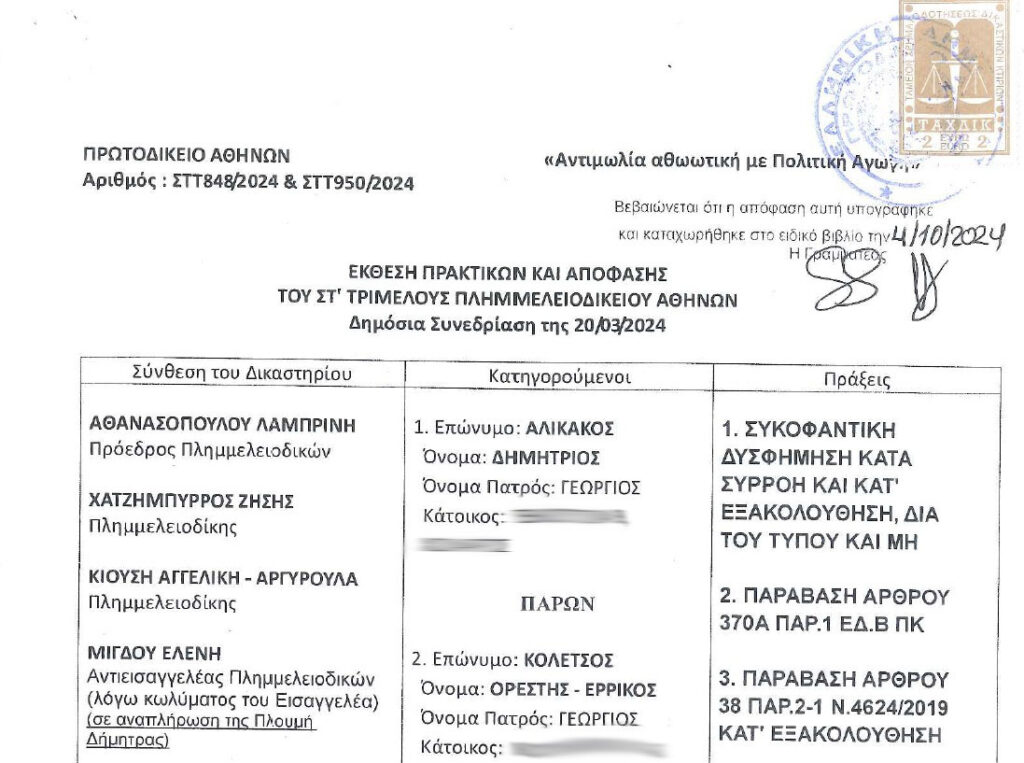
Within the framework of the first defendant’s journalistic investigation into matters pertaining to the history of the Patriarchate, the daily life and mission of the Holy Sepulchre Brotherhood, and more specifically the issue of the annual lighting of the Holy Fire by the Patriarch of Jerusalem, the first defendant initially, from April 2018, began telephone conversations with the first complainant, Archbishop Aristarchos, who was the Chief Secretary of the Patriarchate of Jerusalem. During the aforementioned telephone conversations, a main topic of discussion, among others, was the method of the lighting of the Holy Fire. Indeed, after the discussions that took place between the first defendant and the first complainant, the latter, with the consent of the Patriarch of Jerusalem, proceeded to correct the text on the Patriarchate’s website regarding the ceremony of the Holy Fire, where the word “miracle” was initially mentioned, and another text from 1910 was uploaded, which did not contain the word “miracle” in the ceremony of the Holy Fire.
In July 2018, the first defendant visited the seat of the Patriarchate of Jerusalem for the purpose of conducting the aforementioned investigation. For this reason, the first defendant made a total of three trips to Jerusalem, where he met with many clergy and laypeople of the Patriarchate, and among them met with the complainant, Archbishop Aristarchos, Secretary of the Patriarchate of Jerusalem, as well as Archbishop Isidoros, Sacristan of the Patriarchate of Jerusalem and the absent complainant.
During the discussions that took place between the first defendant and the complainants, it was not proven that the first defendant concealed his journalistic capacity and the investigation he was conducting into the method of the annual lighting of the Holy Fire. The aforementioned fact arises from the complainants’ own reference in their complaint under consideration, on page 4 thereof, where they state that “…During his successive visits to the seat of the Patriarchate, the first defendant spoke with the complainants about the issue of the Holy Fire, which supposedly concerned him primarily as a believer and secondarily as a journalist…”. Furthermore, the aforementioned fact also arises from the clear reference of the second complainant in the lawsuit filed on 2019-07-18 against the first defendant before the Multi-Member Court of First Instance of Athens, where on page 9 he himself states that “…Subsequently, he came to the seat of the Patriarchate initially to cover his personal spiritual needs and additionally to conduct research, among other things, on the issue in question (of the lighting)…” on page 10 of the same aforementioned lawsuit “…the issue (of the lighting of the Holy Fire) concerned him primarily as a believer and secondarily as a journalist…” and on page 11 of the same aforementioned lawsuit “…On one of the last days of his stay in Jerusalem, he asked me to record our conversation, in order for it to be used for his future study, and I did not refuse, but I explicitly emphasized which parts of the conversation would remain private and without any public disclosure or sharing with third parties…”.
Subsequently, the fruit of the first defendant’s aforementioned journalistic investigation was the book titled “REDEMPTION, ON THE HOLY FIRE” which was published by EKKREMES publications, owned by the second defendant, in 2019. In the aforementioned book, the first defendant explains that after conducting an investigation, he concluded that the Holy Fire on Holy Saturday is lit naturally by the Patriarch from a lit lamp supplied to him by the Sacristan of the Patriarchate, citing, among other things, the testimonies of both the first complainant and the party supporting the prosecution, as well as the second complainant.
According to the provisions of Articles 362, 363 of the Penal Code, as currently in force, whoever in any way asserts before a third party or disseminates concerning another person a fact that may harm their honor or reputation, commits the crime of defamation, and if the fact is false and the perpetrator knew of its falsity, then they commit the crime of slanderous defamation. As a “fact”, according to the above provisions, is understood any incident of the external world or a relationship or behavior contrary to morality or decency, provided that they relate to the past or present and are perceptible to the senses, so as to be amenable to proof. Conversely, the expression of an opinion or a specific evaluative judgment or other characterizations do not constitute a fact, unless the above are directly related and connected to a fact that constitutes the critical element of the offense, so as to essentially determine its quantitative and qualitative gravity, which is not the case when they are expressed or manifested independently and irrelevantly in this manner. For the establishment of the subjective element of the crime of defamation, knowledge by the perpetrator is required that the fact asserted or disseminated by them before a third party is apt and suitable to harm the honor or reputation of another, and the will or acceptance by the perpetrator to assert or disseminate before a third party the fact harmful to another, while for the establishment of the subjective element of the crime of slanderous defamation, additionally, knowledge by the perpetrator that the fact is false is required. However, according to Article 367 of the Penal Code, as currently in force, it is stipulated that “the following do not constitute an unlawful act: a) adverse criticisms… as well as, c) expressions made for the performance of legal duties, the exercise of legal authority, or for the safeguarding (protection) of a right or due to another legitimate interest…” and in paragraph 2 that the preceding provision does not apply: a) when the above criticisms and expressions contain the constituent elements of the act under Article 363 (i.e., slanderous defamation), and b) when from the manner of expression or the circumstances under which the act was committed, an intent to insult is evident. Furthermore, according to paragraph 1 of Article 14 of the Constitution, “everyone may express and disseminate their thoughts orally, in writing, and through the press, observing the laws of the State”, and according to paragraph 2 of the same aforementioned article, “the press is free and censorship and any other preventive measure are prohibited”. From these provisions, it is inferred that the press performs a social function, exercising duties which it chooses itself, based on its mission, consisting of informing and cooperating in the formation of public opinion. However, freedom of the press is not an end in itself and therefore should not automatically entail the sacrifice of other legally protected interests. For this reason, under Article 14(1) of the Constitution, it is subject to the general requirement of compliance with the laws of the State, which form the framework within which the press operates freely. Therefore, the freedom of disseminating thoughts and the corresponding freedom of information may be restricted by law, provided that these restrictions are of a general nature, constitute only repressive measures, and do not infringe upon the core of the right to freedom of the press. Moreover, from Article 14 para. 1 of the Constitution, in conjunction with Article 25 para. 3 of the Constitution and Article 281 of the Civil Code, it follows that the right to freedom of the press is subject to restrictions and is exercised within the limits set by the laws of the state, which aim not at hindering freedom of the press in any way, but at protecting citizens and society from the abusive exercise of the right to free expression of opinion or dissemination of information or criticism through the press. Furthermore, Article 10 of the International Convention of Rome, which was ratified and constitutes domestic law (Legislative Decree 53/1974), establishes in paragraph 1 thereof the freedom of opinion and the transmission of information or ideas; however, in paragraph 2 thereof, it provides for the possibility of restricting freedom of the press, stipulating that the exercise of the right to free expression entails duties and responsibilities and may be subject to restrictions or penalties provided by law and constituting necessary measures in a democratic society for national security, public order, the protection of the reputation and rights of others, for preventing the disclosure of confidential information, or for ensuring the authority or impartiality of the judiciary. From the complex of the aforementioned provisions, it is inferred that from the increased risk of infringement of personality inherent in journalistic activity due to publicity, which constitutes the field of action of the press, arise the so-called duties of care arising from the activities of the press, including the obligation to respect personality and the duty of truth, which requires that the truth of information and news be verified beforehand, so that the content coincides with reality. Failure to comply with these duties of care precludes, where false information is disseminated, any finding that the journalist acted out of a legitimate interest in informing the public; consequently, the unlawfulness of the infringement cannot be excluded under Article 367 of the Penal Code (Supreme Court 574/2019, Supreme Court 63^015, Supreme Court 1466/2014, Supreme Court 1940/2014, Supreme Court 1095/2010).
From the same evidentiary means, it is proven that the first complainant and party supporting the prosecution indeed assured him during the aforementioned discussions that the lamp is placed lit in the Holy Sepulchre by the Sacristan on Holy Saturday. The Court is led to the above conclusion because, although the party supporting the prosecution claims in his complaint that the aforementioned conversation did not take place and that the aforementioned fact was not stated by him, before the Court he did not support what was stated in his complaint and did not testify that the aforementioned facts are false and that they were not stated by him, but repeatedly stated that what was said falls under the secrecy of the seal of confession and cannot be disclosed.
Specifically, the party supporting the prosecution did not explicitly testify before the Court that the aforementioned facts were not stated by him to the first defendant and are false facts, but rather that what he discussed with the first defendant took place within the framework of confession and remains confidential, attributing blame to the first defendant for leaking confidential conversations that took place within the framework of confession. Specifically, the party supporting the prosecution testified before the Court, when asked if the aforementioned fact was true or false, the following: “…- This (fact I of the 1st charge) did you say it? – I do not comment on that. Because I also include this in the secrecy of the mystery of confession.”, also at another point in his testimony, when asked, he states the following: “…- I told you that… Excuse me, with your question (if there are defamatory phrases which, when you saw them, you said, ‘seeing this phrase defames me, he told me something that is not true, he said, he told a lie against me that is not true’) I think you are trying to extract me from the framework in which I want to remain entrenched…”. However, the accusation he attributes to the first defendant, that the latter revealed conversations that took place during confession, does not fall within the jurisdiction of this Court.
Therefore, as it appears particularly from the testimony of the party supporting the prosecution, who does not confirm before this Court the untruthfulness of the fact mentioned by the first defendant on pages 34 and 57 of his book, namely that the party supporting the prosecution assured him that the disputed lamp is placed lit in the Holy Sepulchre, it is fully proven that the aforementioned fact was indeed stated by the party supporting the prosecution in most of the discussions that took place between them.
Furthermore, as it appears particularly from the aforementioned videotaped conversation between the first defendant and the second complainant, which took place on 2018-11-26 at the Notre Dame Hotel in Jerusalem and was reviewed by the Court, it is indeed proven that the second complainant admitted to the defendant that the lighting of the lamp in the Holy Sepulchre on Holy Saturday occurs naturally. The aforementioned fact specifically arises from the following excerpt of the conversation between the first defendant and the complainant:
…-(defendant) I don’t want you to go into details, I want to ask, you go inside, you light it above the Holy Sepulchre, and you leave so the Patriarch finds it lit, is that right?
– (complainant) Yes, that’s right…
– (defendant) Is that right?
– (complainant)(nods affirmatively)
– (defendant) Do you also light the lamp of the Guards?
– (complainant) There are two lamps, one brought by the Sacristan and a second one.
– (defendant) And you light that one too?
– (complainant) That one too…
– (defendant) Did you know the exact detail that the Sacristan must light the lamp, or did you also think, like many, that it is placed inside already lit?
– (complainant) Lit? No, it’s visible if it’s lit from inside.
– (defendant) So, when Daniel told you, you weren’t surprised?
– (complainant) No, okay, just confirmation…
– (defendant) Do you believe that, even though you go inside, light the lamp, or rather, place it unlit, light it and leave, each Patriarch has taken his precautions, so that, one in a million, he has a light source on him?
– (complainant) Well, I don’t know what to say now… In my estimation, he surely has something, if something goes wrong, I don’t know what he would do at that moment… We cannot, now that we are in the Holy Sepulchre, say that we are performing a miracle, that the respective Patriarch enters the Holy Sepulchre and prays and the flame lights by itself… There are some things that do not stand to reason…”
– (defendant) So, the miracle is the sanctification?
– (complainant) Exactly.
– (defendant) The lighting of the flame is a natural process.
– (complainant)…of the flame
Consequently, from the above, it is proven that the fact stated by the first defendant on page 75 of his book is true, namely that in a discussion with the second complainant in July 2018, the latter admitted that the lighting of the lamp in the Holy Sepulchre on Holy Saturday is done by him naturally, i.e., with a lighter. Furthermore, what the first defendant states on his personal social media/Facebook page regarding the complainants Antonios – Aristarchos Peristeris and Ilias Isidoros Fakitsas is true: a) on 2019-03-14 “…No, I don’t have the right. It was the truth. Confessed by the protagonists of the ‘miracle’ themselves with elements of drama…”, b) on 2019-03-16 “And not the testimonies of leading clerics of the Patriarchate of Jerusalem who confirm as protagonists of the ceremony that it is not a miracle. Wrong, they do not confirm. They explain exactly how they prepare and implement the trick. THEY THEMSELVES..” and c) on 2019-03-19 “ANSWER. What exactly is a fabricated story?…That Archbishop Isidoros admits that he also lights this lamp as a ‘safety valve’? Yes, he admitted it.”
In light of the foregoing, and given the truth of the aforementioned facts, the first defendant must be acquitted of the charge of defamation, both through the press and otherwise, committed repeatedly and continuously, as the elements of the offense are not objectively established. Furthermore, the aforementioned true facts recorded by the first defendant in his book and published on his website are not intended to harm the honor and reputation of the complainants or their personality in general, nor do they offend them, nor do they express contempt towards them. On the contrary, the book presents the complainants as champions of truth, as courageous clergy who found the boldness to reveal to the world the process of the Holy Fire.
Furthermore, the descriptions he used in his aforementioned personal account serve to protect the public’s right to information on a matter of broader interest. Therefore, in any case, the unlawful nature of the act of simple defamation is lifted in application of the provision of Article 367 para. 1c of the Penal Code, as the aforementioned content was published by the first defendant out of justified interest, without exceeding the necessary scope.
Specifically, it was proven that the first defendant acted exclusively out of justified journalistic interest, in the exercise of the constitutionally guaranteed right to disseminate information and freedom of the press, with the sole purpose of informing the public on a matter of general interest, presenting his findings objectively and citing testimonies on the subject, without any intent to insult the complainants. Therefore, the first defendant must also be acquitted of the offense under Article 362 of the Penal Code, while the second defendant must also be acquitted, because, as the owner of EKKREMES publications, he proceeded with the publication of the book titled “Redemption, On the Holy Fire” which was authored by the first defendant.
According to Article 3704 para. 1 of the Penal Code, in force since 2019-07-01, it is stipulated that “… Whoever unlawfully intercepts or in any other way interferes with a device, connection, or network providing fixed or mobile telephony services, or with a hardware or software system used for providing such services, with the aim of himself or another person learning or recording on a physical medium the content of a telephone conversation between third parties or data regarding the location and movement of such communication, shall be punished with imprisonment. The same penalty applies to the act of the preceding paragraph when the perpetrator records on a physical medium the content of his telephone communication with another person without the latter’s explicit consent.” The above provision was enacted within the framework of the general protection afforded to individuals by the provisions of Articles 2§1, 5§1, 9 A’ 19 and 25§1 para. d’ of the Constitution and Article 8 of the ECHR, which has (according to Article 28 §1 of the Constitution) supra-legislative force, stating that “everyone has the right to respect for his private and family life, his home and his correspondence. There shall be no interference by a public authority with the exercise of this right except such as is in accordance with the law and is necessary in a democratic society in the interests of national security, public safety, for the economic well-being of the country, for the prevention of disorder or crime, for the protection of health or morals, or for the protection of the rights and freedoms of others.” From the above provisions, it follows that the recording of a private conversation without the knowledge and consent of the interlocutors, or the videotaping of a person’s personal and private life without their consent, constitutes a restriction and limitation on the free exercise of communication and private life, respectively.
From the same evidentiary means, it was not proven that the defendant committed the objective elements of the offense of recording the content of telephone communication on a physical medium without consent, concerning the first complainant, as it was not established that the first defendant recorded on a physical medium the content of his telephone communication with the party supporting the prosecution. Specifically, the book authored by the first defendant refers to the content of the telephone conversations that took place between him and the party supporting the prosecution, listing in the book the dates these telephone communications occurred, namely on 2018-04-12, 2018-04-19, 2018-05-25, 2018-05-30, 2018-06-07, and 2018-06-20, their exact times, and their duration. However, from the above data, it does not appear that the aforementioned telephone communications were recorded on a physical medium by the first defendant, i.e., they were not recorded on audiotape or videotape or a similar fixed medium, or an analog or digital recording device. On the contrary, the same evidentiary elements showed that the first defendant, as a journalist, reported the content of their aforementioned telephone communications in the book he published. The first complainant bases his claim regarding the recording of his telephone communications on the mention in the book of the exact time the telephone conversations took place, as well as their duration. However, the aforementioned data are directly derived from their automatic storage on modern telephone devices (mobile smartphones, etc.). Consequently, the first defendant must be acquitted of this charge against the first complainant. Furthermore, the first defendant is alleged to have recorded on a physical medium the content of his telephone communication with the complainant Ilias-Isidoros Fakitsas on 2018-11-26. However, it is not proven that a telephone communication took place on the aforementioned date between the first defendant and the second complainant.
On the contrary, it is proven that on 2018-11-26, a videotaped conversation took place between the first defendant and the complainant Ilias-Isidoros Fakitsas, at the Notre Dame Hotel in Jerusalem, and indeed, the aforementioned videotaped conversation occurred with the approval and consent of the second complainant. This fact is proven by the observation of the disputed videotaped conversation, which shows that the camera was placed in a prominent position directly in front of him, on the table, that the second complainant himself verbally referred to the presence of a camera, and that he looked directly into the camera. Specifically, as shown in the video recording, the second complainant states at one point: “…Shall we say it on camera?” a fact that proves he knew he was being videotaped and consented to this videotaping. Therefore, he must be acquitted of the charge of violating privacy against the second complainant.
Furthermore, Article 38 of Law 4624/2019 provides for criminal penalties for anyone who, without authorization, 1) interferes in any way with a personal data filing system, and by this act gains knowledge of such data, copies, removes, alters, damages, collects, records, organizes, structures, stores, adapts, modifies, retrieves, searches for information, correlates, combines, restricts, erases, destroys it, and 2) uses, transmits, disseminates, communicates by transfer, makes available, discloses, or makes accessible to unauthorized persons personal data obtained according to case (a) of paragraph 1 or allows unauthorized persons to gain knowledge of such data. Furthermore, according to Article 9A of the Constitution, which was added during the 2001 revision to harmonize with European law, “Everyone has the right to protection from the collection, processing, and use, especially by electronic means, of their personal data, as provided by law. The protection of personal data is ensured by an independent authority, which is established and operates as provided by law.” This article enshrines the right to the protection of personal data, i.e., the right to so-called “informational self-determination” or “self-disposition of information.” Such data are considered not only those referring to private life but also those intended for disclosure in the public sphere, and furthermore, protection refers not only to the processing of such data by state bodies but also by private individuals. Additionally, according to Article 28 para. 1 of the aforementioned Law, it is stipulated that “To the extent necessary to reconcile the right to the protection of personal data with the right to freedom of expression and information, including processing for journalistic purposes and for purposes of academic, artistic, or literary expression, the processing of personal data is permitted when:… c) the right to freedom of expression and the right to information outweigh the right to protection of the data subject’s personal data, especially for matters of general interest or when it concerns personal data of public figures.” Subsequently, paragraph 2 of the aforementioned article exempts processing for journalistic purposes from the scope of most chapters of the GDPR, including Chapter II on consent and legal bases, and Chapter III on the rights of the data subject, such as the right to information, access, rectification, erasure, and objection.
In the present case, it appears that, in March 2019, the first defendant published photographs of the second complainant in the book he had written and published, as can be seen on pages 57, 59, 60, 62, 64 and 113 of the book. It also appears that, in March 2019, he uploaded to YouTube the recorded conversation between himself and the second complainant. However, the email correspondence between the second complainant and the first defendant shows that, on 16 November 2018, the second complainant had sent the first defendant, by email, photographs of himself taken on the relevant day of the Holy Fire ceremony. In a reply dated 17 November 2018, the first defendant thanked him and asked whether he could include the photographs in the book he was preparing on the Holy Fire. The second complainant did not reply to that message. Nine days later, however, on 26 November 2018, the aforementioned recorded conversation between the two men took place at the above-mentioned hotel in Jerusalem. The second complainant thereby consented not only to the inclusion of his photographs in the book that the defendant intended to publish, but also to being recorded on video.
Furthermore, the publication of the aforementioned videotaped conversation was fully covered by the consent of the second complainant, who was aware of the first defendant’s journalistic capacity, the purpose of his successive visits to Jerusalem, his interest in the process of the Holy Fire’s Ignition, and his intention to make public what was communicated to him. The above fact, namely that the aforementioned conversation would be made public, is evident from the content of the videotaped conversation itself, in which the second complainant explicitly states that he cannot lie publicly about the matter of the Holy Fire’s Ignition, while the first defendant states that he hopes the publication of the testimonies will redeem the brotherhood, making it clear to him that he intended to publish this specific videotaped conversation: Specifically:
” …- (complainant) That’s what we’re trying to do, okay, let’s not go into details now, let’s not offend the religious feelings of every person who comes from Greece, with the experiences they have lived…”
– (defendant) Agreed, but how it lights is not a miracle!
– (complainant) No, that goes without saying.
– (defendant) So, we can’t say that?
– (complainant) Yes, we can say it, and many spread it, some freely and for years, not just today.
– (defendant) And I see that it’s truly impressive that you, as a Skevophylax, decided to say it; you are saying it, in a certain way, of course, but you are saying it.
– (complainant) Well, yes… I can’t go public and lie about what exactly is happening; we must believe the religious aspect, just as in the liturgy…
– (defendant) I believe that after the publication of the testimonies on this specific matter—which I believe will be out of love for the brotherhood and people’s faith—most people will understand the essence. The sanctification, the divine Grace… and—I don’t know if you agree—the phenomenon has been going on for about eleven centuries, as we estimate it.
– (complainant) Yes….
– (defendant) and I hope all this leads to something—which perhaps—I don’t know, I’ll say it as I think it, to redeem the entire brotherhood, to redeem it, to lift this burden from you, that something must be hidden. I don’t know, what do you say?
– (complainant) We’re not hiding anything…”
Furthermore, from the same evidentiary means, it is proven that the defendant posted the first complainant’s photograph in his book, on page 65 thereof. In this specific photograph, the first complainant is depicted in his office in Jerusalem, wearing his kamilavka, with the first defendant standing next to him. No explicit consent from the first complainant for the aforementioned posting was established; however, the unlawfulness of the said act is waived in application of Article 28 para. 1 case c of Law 4624/2019, inasmuch as the first complainant and party supporting the prosecution is a public figure, specifically the Chief Secretary of the Patriarchate of Jerusalem, with whom the defendant repeatedly conversed about matters concerning the Holy Fire process during his journalistic investigation, which he subsequently, as was his right due to freedom of expression, made public. Therefore, in this specific case, the defendant’s right to freedom of expression and information outweighed the first complainant’s right to protection of personal data concerning this specific photograph, which is neither offensive nor pertains to the complainant’s private life, as it depicts him in his office with the defendant standing next to him during the relevant conversations. In view of the foregoing, the defendant must be acquitted also of the offense of continuous violation of Article 38 para. 2-1 of Law 4624/2019 attributed to him.
TRIES the first defendant, who appeared in person: Surname: ALIKAKOS First Name: DIMITRIOS Father’s Name: GEORGIOS
TRIES the second defendant, represented by counsel:
Surname: KOLETSOS First Name: ORESTIS – ERRIKOS Father’s Name: GEORGIOS
FINDS the defendants NOT GUILTY”
→ (The Decision in pdf format here)