
How Is the Holy Fire Lit? Summary and Conclusions
The evidence presented in this investigation — including testimonies, audiovisual material and court rulings — shows that the flame is lit through human intervention. Before the Patriarch enters the Holy Sepulchre, the sacristan lights two oil lamps inside the Edicule. The Patriarch and the Armenian priest then take the flame from the already lit lamps and pass it on to the faithful.
Key Findings of the Investigation – Timeline
- The Patriarchate of Jerusalem withdrew the word “miracle” from its official texts (2018).
- Archbishop Isidoros (sacristan) revealed in 2018 that the lamp is lit with a lighter. (His testimony was made public in 2019)
- The ceremony includes another lamp, as a “Fail-Safe”, which he lights himself, as he revealed.
- The court decisions of 2024 confirmed the accuracy of the testimonies.
- Judicial decision 2611/2026 ruled that the lighting of the Holy Fire in Jerusalem “is the result of human intervention”. The decision became final on June 23, 2026.
On April 12, 2018, the Chief Secretariat of the Patriarchate of Jerusalem informed me that the Patriarchate does not use the word “miracle” in its official texts. On the same day, I sent them the official posted text, concerning the Holy Fire, which contained the critical word. From that moment, the process of changing the text began.
On June 23, 2018, the Patriarchate withdrew the word “miracle” regarding the Holy Fire. The old text was replaced with a completely different description of the ceremony that did not mention a miracle.
A few days later, Patriarch Theophilos III himself, in a private meeting I had with him, clearly stated: “There is no miracle.” However, he avoided giving a clear answer to the question “how the Holy Fire is lit.”
This was followed by the photographing of the “Unsleeping Lamp” -for the first time in its storage area- and the confirmation that it is placed unlit inside the Holy Sepulchre.
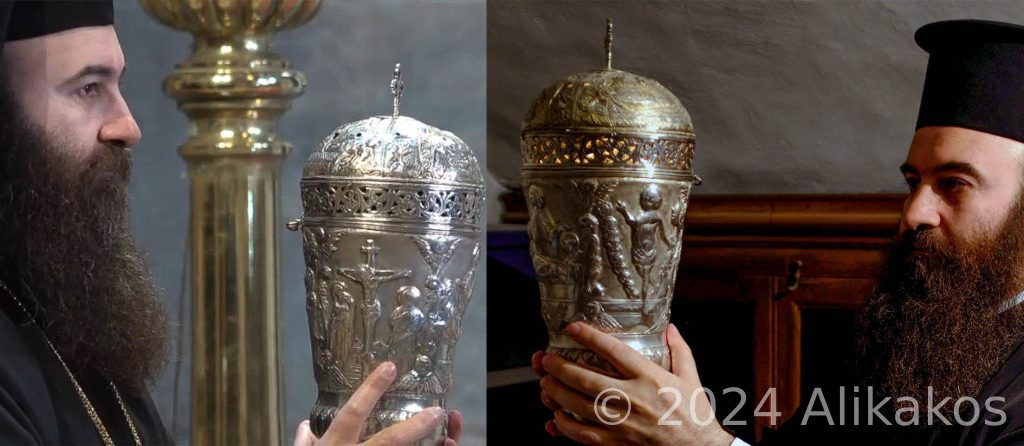
The logical impasse gave way to a revelation that no one had imagined and has not been recorded until today: for about 150 years, every Holy Saturday, the lamp above the Tomb of Jesus is lit by the hand of the sacristan with a lighter (or with a flint in the years before lighters). In fact, a second lamp is also lit as a fail-safe, as Archbishop Isidoros, sacristan of the Holy Sepulchre, admitted.
That is, the first lamp is not placed lit and then extinguished by some… divine intervention (only to be relit shortly after), but enters unlit and is lit at the same moment by human hand. The exact same thing happens with the second lamp.
The crucial “detail”: the lamp is lit inside the Holy Sepulchre
This very revelation —“a detail most people are unaware of” (he meant within the Brotherhood), as Isidoros described it— was what shocked the Patriarchate. It was not only the fact that the patriarch lights his candles from an already lit lamp, a revelation that shocked many believers, but that this lamp enters unlit and is lit inside the Holy Sepulchre, on the burial slab, with a lighter.
The difference (entering with a lit lamp – entering with an unlit lamp and lighting it in front of the Tomb) may seem insignificant, as it does not change the essence of the absence of a miracle, but at the level of religious ritual, it is significant and even more shocking, as it points to a secular “magic” trick, which, with various variations, has been maintained for over a thousand years.
In 2018, when I was researching the phenomenon, I did not realize this difference. I later understood —after the lawsuits and legal actions to make Isidoros’s video disappear— recalling a phrase from Aristarchus, when I announced to him that I would reveal the truth (which he didn’t know exactly): “Beware! There is a truth that can shake us and a truth that can flatten us.”
The myth of the “Tomb sealed with sealing wax until the Patriarch enters”
From the moment the sacristan exits until the Patriarch enters, no one enters the Holy Edicule. The door is closed with a ribbon. Conversely, the so-called “sealing” of the Tomb, which occurs quite some time before the sacristan enters, is a misleading term. The soft wax spread on the door, and its subsequent sealing with stamps by the Muslim doorkeeper of the Church of the Resurrection, is an act symbolizing “So they went and made the tomb secure by sealing the stone and setting a guard” (Matthew 27:66).
Watch the video.
In numerous media outlets, we read that “The Tomb is sealed with sealing wax and its wooden doors open only when the Greek Patriarch arrives to enter the Tomb.”
This is false, as shown by the fact that the sealing wax is removed so that the sacristan—not the Patriarch—can enter carrying the lamp. Thus, by the time the Patriarch enters the Holy Sepulchre, there are—demonstrably—two lit lamps in front of him. At this point, we are no longer making assumptions or speculating. There is no doubt about the source from which the Holy Fire is lit. In addition to the historical testimony of Archbishop Isidoros, the video showing the light from the already lit lamp at the moment the Patriarch enters is also irrefutable evidence. Watch the documentary video.
In addition to the revealing testimonies of a current and a former sacristan —Isidoros and Nikephoros— the words of the Archbishops of the Holy Sepulchre, Aristarchus, Cornelius, and Theophanes, confirmed the natural origin of the Holy Fire.
The 7 Stages of the Ceremony (according to testimonies)
Therefore, the stages of the Holy Fire ceremony, according to the testimonies of its protagonists and audiovisual material, are the following seven:
- Placement, early in the morning, of a red glass oil lamp inside the Tomb of Christ by the senior guardian.
- Sealing the door of the Holy Edicule with soft wax, and stamps upon it by the doorkeeper of the Church, in remembrance of: “sealing the stone and setting a guard” (Matthew 27:66)
- Removal of the wax. The sacristan, who is also the abbot of the Church of the Resurrection, then enters and places an unlit lamp in the Holy Sepulchre. The lamp and the red glass lamp are then lit, and the door is closed with a ribbon.
- Procession of the Patriarch and hierarchs, three times around the Edicule.
- Entry of the Patriarch and the Armenian priest into the Holy Sepulchre. (In recent years, a representative of the Israeli police also enters)
- Prayer of the Patriarch and the Armenian priest in front of the Holy Sepulchre. Subsequently, the flame is taken from one of the two lit oil lamps.
- Distribution of the Holy Fire first from the two openings, right (by the Orthodox Patriarch) and left (by the Armenian priest) of the Edicule. Subsequently, the Patriarch and Armenian priest exit, and the Holy Fire is distributed to the faithful in front of the Edicule.
The Logic of the Two Lamps — Fail-Safe
The use of two lamps creates a practically fail-safe mechanism for producing a “miracle”. It almost eliminates the possibility of something going wrong. One lamp might go out. But the chances of both lamps going out during the roughly 45 minutes between the time they are lit and the Patriarch’s entry into the Holy Sepulchre are extremely small.
We do not know exactly when the two lamps began to be placed. There are no written testimonies. Both previous Patriarchs and sacristans who are no longer alive took the secret with them. However, there are two points regarding the dating of the main lamp’s ritual that we should consider.
The first is the testimony of the sacristan, who speaks of the lamp’s construction around the mid-19th century. The second, and perhaps more important, is Miliaras’s reference in 1934. The blessed Archimandrite was born in 1865 and settled in Jerusalem at the age of fifteen, i.e., in 1880. It is therefore obvious that when he speaks of the existence of a “lamp” in the chapter “Description of the contemporary ceremony of the Holy Fire,” he is not referring to the period in which he wrote the study, but to a tradition he found alive when he arrived in the Holy Land. We can reasonably assume, then, that the sacristan’s lamp appeared in the ritual before 1880.
Και πριν από την παρουσία της συγκεκριμένης κανδήλας στο τελετουργικό, πώς άναβε το Άγιο Φως; Στο ερώτημα αυτό δεν μπορούμε να απαντήσουμε με βεβαιότητα. Μεσαιωνικοί μουσουλμάνοι συγγραφείς που ασχολήθηκαν με την τελετή διασώζουν διαφορετικές εκδοχές για τον τρόπο ανάφλεξης. Ορισμένοι περιγράφουν σύνθετους μηχανισμούς με κουτιά, σκοινιά και εύφλεκτες ουσίες, οι οποίοι, σύμφωνα με τις αφηγήσεις τους, προκαλούσαν την ανάφλεξη. Μια διαφορετική και απλούστερη περιγραφή δίνει, τον 13ο αιώνα, ο Sibṭ ibn al-Jawzī (†1256). Ο ίδιος αναφέρει ότι έζησε δέκα χρόνια στην Ιερουσαλήμ και ότι διερεύνησε προσωπικά τον τρόπο με τον οποίο άναβαν οι λυχνίες κατά την «Εορτή του Φωτός». Σύμφωνα με τη μαρτυρία του, σε εσοχές ενσωματωμένες στο μάρμαρο υπήρχαν λυχνίες που είχαν ανάψει ήδη από τα χαράματα. Όταν ο χώρος σκοτείνιαζε, ένας ιερέας άνοιγε κρυφά μία από τις εσοχές, άναβε ένα κερί από μία από τις αναμμένες λυχνίες και στη συνέχεια ανακοινωνόταν ότι «κατέβηκε το Φως». Η περιγραφή αυτή περιλαμβάνεται στο Mirʾāt al-zamān (σ. 277) και παρατίθεται επίσης από τον ιστορικό Moshe Gil στο A History of Palestine, 634–1099 (σ. 467).
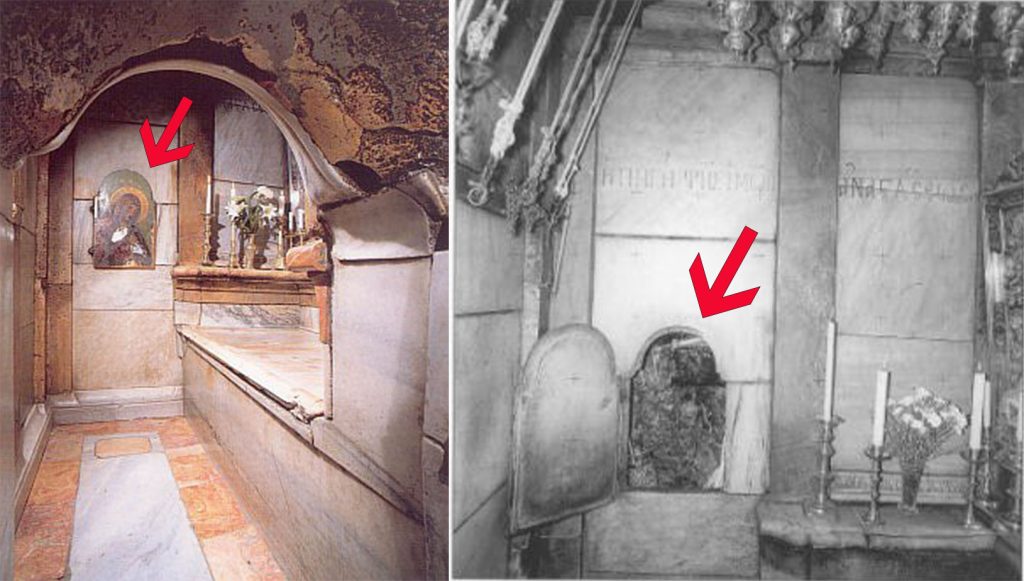
Six centuries later, Bishop Porphyrios supported the exact same thing (a hidden lamp), as we will see next. We cannot rule out anything for that era. However, a place resembling a marble crypt still exists today in the Holy Sepulchre, and there is no source explaining its existence.
Historical Testimony from 1775: “No one dares to tell the truth”
This reference, included in the foreword to my book by Stavros Zoumboulakis, President of the Supervisory Board of the National Library of Greece, is particularly significant because it cites, as early as 1775, a description of the ceremony according to which the light does not descend miraculously but is lit through human intervention:
“Nikephoros Theotokis receives from Eleutherios Michael the Larisian the question: ‘Is the light appearing in the God-receiving Tomb of the Savior on the Lord’s Day of Pascha true or a fabrication?'” In his answer (January 23, 1775), after initially clarifying that what he is about to say he had heard the account directly from senior churchmen of the Church of Jerusalem, he is absolutely clear about what is truly happening and why this truth is being concealed:
What happens in our days, I will tell you, which I have heard from the leading men of that place, who are very trustworthy and worthy of all respect and reverence, some of whom have fallen asleep in the Lord, while others are still living. It does not descend from heaven, nor does it spring forth from the tomb, but the hierarch appointed to this ministry, having entered the so-called Edicule, strikes the flint and produces fire above the life-giving Tomb, then, having lit the candles previously rubbed in the Tomb, he exits holding them and transmits the light as sanctified by the contact and touch of the Holy Sepulchre. And the common people believe that light sprang forth from the tomb, but no one dares to tell them otherwise, being afraid of suffering something terrible. As you see, therefore, it is not a fabrication, for they neither invent nor construct anything at all, nor do those presiding there conceal what happens when asked privately, but being unable to cure the perception of the common people, they remain silent by way of ecclesiastical economy; for such a perception causes no harm. (K. I. Dyovouniotis, “Nikephoros Theotokis”, reprint from the journal Nea Sion, Holy Community of the Holy Sepulchre, Jerusalem 1913, p. 15.)
Note:
The Greek version of this page also includes a Modern Greek rendering of the historical text quoted above.
And Zoumboulakis continues: “The technique of lighting the Holy Fire may be different today, but everything else has remained the same: the Brotherhood of the Holy Sepulchre knows the truth, they say it privately but do not confess it publicly, either because they are afraid or because they cannot correct the opinion of the many (the phrase ‘common people’ does not have the derogatory meaning we attribute to it today), since, after all, such an opinion does not cause them spiritual harm.”
That was in 1775. The significance of this testimony is twofold: on the one hand, it explicitly describes the flame being lit by human intervention; on the other, it records, even at that time, the fear of publicly revealing the practice. If there is one thing we should take from the above testimony of the Archbishop of the southern provinces of the Russian Empire—apart, of course, from the revelation that the Holy Fire is lit with a tinderbox—it is precisely this: the fear of speaking the truth publicly, and the belief that what takes place does not constitute fraud, but rather corresponds to what ordinary people want to believe. And yet, when “questioned in private,” they tell the truth.
So what do they mean when they say that it is not a “fabrication”? Are they really telling the truth? And how many of them are?
Bishop Porphyrios’s Testimony: “They will tear us apart if they find out”
Even more revealing is the written testimony of Bishop Porphyrius, founder of the Russian Ecclesiastical Mission in Jerusalem in 1847. Citing his conversation with the patriarchal chaplain, Bishop Dionysius of Philadelphia (later Metropolitan of Bethlehem), where the latter revealed to him that due to the stratagem (“a lamp hidden behind a movable marble icon”) of lighting the Holy Fire, they almost exposed themselves to Ibrahim, Pasha of Egypt (known from the Greek Revolution), Porphyrius writes:
“After recounting all this, the metropolitan added that the cessation of our pious falsehood is expected only from God. As He knows and can, so He will guide and calm the peoples who now believe in the miracle of the Holy Saturday light. We cannot even begin this change in thought, because they will tear us to pieces in front of the very chapel of the Holy Sepulchre.” (The Book of My Existence. Petersburg, 1896. Volume 3. Pages 299-301)
Everything indicates that everyone —or almost everyone— knows. This is what I understood and what can be inferred from the testimonies. The “initiated” can be divided into four main categories: Those who, even though they know, insist on speaking of a miracle. Those who avoid any discussion on the matter or describe it with ambiguities and half-truths. Those who share the secret —on a personal level— if they perceive that you can handle it. Finally, the very few who state it publicly. As for the “detail,” this seven-sealed secret, very few know it.
It is worth noting that with this “trick,” not only is the smooth process of lighting the Holy Fire ensured, but also, in addition, each Patriarch maintains a certain distance from the “impious act,” as he is not the direct perpetrator. He is not present, he does not light his candles himself with his lighter, as many “light-fighters” and skeptics mistakenly assume. This “role” has been assigned, for centuries, to a person beyond all suspicion. To the sacristan in office. Theotokis also states: “the hierarch appointed to this ministry.”
It is indicative that when he approaches the Holy Edicule and stands there for a few minutes with the lamp in his hands, before subsequently entering the Holy Sepulchre, very few pay attention to him. If we carefully watch the scene on television, he passes almost unnoticed.
Why does the sacristan with the lamp go unnoticed?
It is a fact that in recent decades, when television channels cover the Holy Fire ceremony, when the moment came for the sacristan to approach the Holy Sepulchre with the lamp in his hands and stand for about five minutes in front of the Edicule, no journalist or theologian commented on his presence.
Many times the camera —despite the crowd of faithful around him— clearly recorded him, but no mention was made, nor did anyone question the reason for his presence. The same applied to the faithful inside the church. Rarely did we see a persistent gaze fall upon him in any shot.
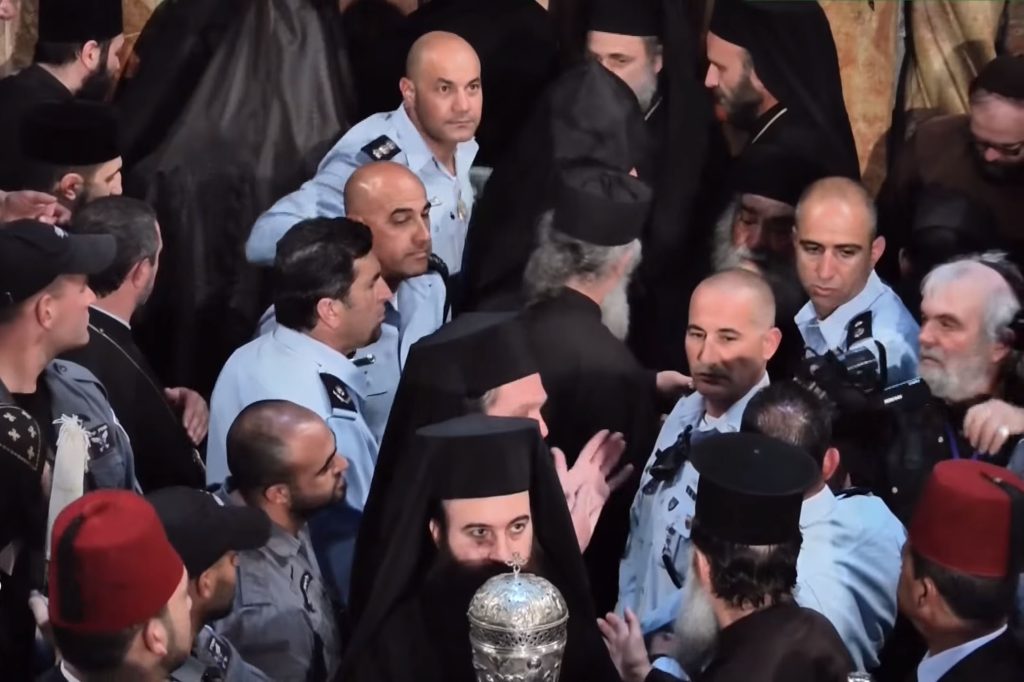
This can be explained as follows: he is one hierarch among many others. He is not holding anything that appears to have a flame, such as a lit lamp. The object he is carrying may look unusual, but it does not arouse suspicion. Most importantly, however, the faithful are there for one reason only: to see the Patriarch emerge with the candles lit—in other words, to witness the miracle. Everything else is irrelevant.
On the other hand, journalists do not feel the need to investigate or even question the phenomenon of the sacristan’s presence. The day is joyous, and nothing should spoil the narrative. The theologians, some of whom are aware, overlook it for the same reason.
Thus, the sacristan enters unnoticed, and exits and departs just as unnoticed, even if the ‘object’ is no longer in his hands.
But let us assume that a skeptic decides not only to observe him but also to satisfy his tormenting curiosity at that moment by opening the cover of the lamp —an extreme case, which has never happened— what would he see? An unlit lamp. And curiosity would meet a logical impasse. A traumatic experience for a rationalist.
How the Trick Works: Simple and Ingenious
This is precisely where the ingenuity of the trick lies, which has two main characteristics: First, it is simple in conception and execution by a person who does not play a leading role in the Ceremony. And second, precisely because it is simple, it has managed to direct the suspicions of skeptics to two mistaken assumptions, sometimes certainties: that the lamp enters lit or that it enters unlit and the Patriarch lights it with a lighter. Of course, these latter two options are simple, but they involve enormous risk.
The first option carries the risk of someone opening the cover during the sacristan’s wait outside the Holy Edicule. The sight of the flame, live on air, would constitute a huge scandal. The second could be catastrophic if the Armenian decided to record the scene with a camera or camcorder. But now he cannot do it. Or, more correctly, he has no reason to do it. Let’s see why.
What the Armenians Say About the Holy Fire
Many claim that the Armenian priest who enters the Holy Edicule, along with the Greek patriarch, and has the opportunity to see the lit lamp above the Holy Sepulchre, could have, over so many years, revealed the stratagem, given the rivalry between the two communities. When I raised the issue with Archbishop Theophanes, I received the following answer: ‘But they have been doing it for years now, wherever they go. They say exactly what they see, that is, that the Holy Fire is lit from the lamp. If they saw a miracle, they would not remain Monophysites. They would become Orthodox. The fact that they do not see a miracle leads to the obvious: that they know and accept, for centuries now, how the Holy Fire is lit.’
Theophanes is right. Both Greeks and Russians (as well as other Orthodox peoples) are unaware that the Armenians revealed the secret many years ago, and others who know do not believe them. The most provocative revelation —but not the first— which caused a storm of reactions, occurred in 2018.
Armenian priest Samuel Agoyan, who was present three times at the lighting ceremony inside the Holy Sepulchre, did not see, as he said, a flame coming out of the Tomb, but saw a lit lamp and from there the patriarch lit his candles.
Let’s watch the video:
The Armenian Patriarchate in Jerusalem may be silent, but in 2014, in the official newspaper (p. 4) of the Armenian Church in Russia, theologian David Beknazaryan, a representative of the Church, wrote: ‘We do not bring down fire from heaven, but we remember the Resurrection of our Lord Jesus Christ, who is the true Light. We light fire from the lamp on the slab of the Holy Sepulchre as a source of Light and bring this Light as a symbol of the Risen Savior to the faithful people. There is no miracle here. It is merely a liturgical festive ceremony. It is an ordinary natural fire, which the Greek archimandrite [sacristan] lights in two lamps in the most ordinary way‘ (here the text stored in digital format).
A few days before Easter 2024, on April 21, ‘Lousan’ (as the Armenian priest who enters the Holy Sepulchre with the Greek Orthodox patriarch is called, as the Armenians affirm – the word means ‘he who brings the light’) Archimandrite Aspet Balyan, stated: ‘It is true that there are two lit lamps there. From there, the Patriarch and I light our candles’ (source here).
Complementing Theophanes’ thought, we would say that the already lit lamp above the Holy Sepulchre is the only way that does not provoke and, crucially, does not reveal the ‘detail’ that the sacristan carries out shortly before. And after all, not only the Armenians but also the representatives of other denominations know that there is no other way for the Holy Fire to ’emerge.’
What Do the Churches Know About the Holy Fire? “Everyone Knows”
Equally unfounded is the claim that ‘the Jews would debunk the miracle of the Holy Fire if they could.’ Here, the answer is much simpler: they have no desire to debunk a phenomenon around which their city’s economy revolves and relies. And let’s not forget that inside the Holy Edicule, on Holy Saturday, in recent years, the head of the Israeli police of the Old City also enters. And he sees everything. If he saw a miracle, he would not remain Jewish. And if he wanted to cause harm, he would record the scene with his mobile phone and leak it to the media.
When, during my research, I asked the Chief Secretary of the Patriarchate, Archbishop Aristarchos, ‘How many and which denominations here in Jerusalem know that it is not a miracle?’, he replied as follows: ‘Everyone knows.’
But all Orthodox Churches outside Jerusalem also know, and remain silent (e.g., the Church of Greece). Only the Russian Orthodox Church —while knowing, as Archbishop Theophanes assured me— speaks publicly of a miracle. That is, in the case of Russia, we have a conscious falsehood.
The words of Metropolitan Gregory of Leningrad and Novgorod (+1955) to the theologians of Leningrad are revealing: “I know that this [miracle] is just a legend! But do not touch pious legends, otherwise faith itself will fall!”
The Stance of the Church of Greece
The Church of Greece has not officially taken a stance on the ‘miracle of the Holy Fire.’ However, after the truth was revealed by the Abbot of the Holy Sepulchre, Archbishop Isidoros, and on the occasion of the restrictive measures due to the pandemic that led to the decision not to distribute the Holy Fire from Jerusalem to the churches, Archbishop Ieronymos of Athens and All Greece, in an interview on April 4, 2020, made a historic statement: ‘In the past, before what happens today for the reception of the Holy Fire, they would take the light from the lamp of the Holy Altar,’ and he added, emphasizing: ‘Therefore, there is no first-class and second-class Holy Fire.’
It was the first statement by a head of the Church of Greece who, while not formally stating how the Holy Fire is lit in Jerusalem, essentially did so by deconstructing the claim of ‘Uncreated Light’ (a miracle).
A few days earlier, Metropolitan Anthimos of Alexandroupolis had made a similar statement: ‘Let us never forget that the Holy Fire is the same light that every simple priest brings forth every Holy Saturday evening from behind the Holy Altar, saying the same words that are spoken in the Church of the Resurrection in Jerusalem. […] It is exactly the same Light.’
After this statement by Anthimos, I contacted him to find out if he intended to go a step further by clearly stating the truth. He replied that ‘it is still early, this needs to happen gradually’ and continued: ‘However, if you hear a theologian speaking of “uncreated light” in Jerusalem, know that they have no idea about theology.’
Around mid-February 2022, I contacted the press representative of the Standing Holy Synod of the Church of Greece, Metropolitan Timotheos of Thessaliotis, to find out if the Church of Greece could take a stance on the matter.
On February 25, 2022, he called me back, after speaking with the Chief Secretary of the Patriarchate of Jerusalem, Aristarchos, as he pointed out, and told me that ‘it is very difficult to tell the truth to the faithful.’
Reaction of the Moscow Patriarchate to my acquittal
The news of my acquittal was published in several Russian media outlets, with the state news agency TASS as the original source, which presented it without comment under the title: ‘Athens Court Acquits Journalist Who Wrote Book on Holy Fire.’
It is noteworthy that, a few days later, the Moscow Patriarchate felt the need to publicly comment on the decision of the Greek Justice system. The head of the Synodal Missionary Department of the Moscow Patriarchate, Bishop Evfimy, speaking to the state news agency TASS, referring to ‘the reports in the Greek media about the acquittal by the court of journalist Dimitris Alikakos, who wrote about the origin of the Holy Fire “from a lighter”,’ stated:
‘To take these reports seriously is somewhat strange for an Orthodox person, because it is an attempt to desecrate not merely a great ancient tradition, but essentially a mystery. In the Greek tradition, what happens on Holy Saturday in the Holy Sepulchre is called the “Mystery of the Holy Fire” or the “Mystery of the Manifestation of Light.” I believe that such reports will in no way be able to overshadow the joy of Easter for those who have personally experienced the grace of the descent of this holy light.’
According to TASS, Metropolitan Evfimy ‘expressed doubt that this “deception,” if it were indeed such, could have for centuries gathered such an enormous number of pilgrims in the Church of the Holy Sepulchre, ready to stand for several hours awaiting the Holy Fire.’
Subsequently, the Agency quoted a statement from another representative of the Russian Orthodox Church:
“For us, it is sufficient that the Patriarchate of Jerusalem officially protested against all these reports, while the decision taken by the secular court of Athens is its internal affair. However, we remember that Greece recently adopted, for example, a law legalizing same-sex marriages, so there is nothing strange in all this — these are phenomena of the same order. We may regret it, but it should not surprise us.”
Finally, the popular Russian news website gazeta.ru made extensive reference to my acquittal in an article titled: “Archbishop Isidoros and the Lighter: The Mystery of the Holy Fire Revealed”
The website article ironically concludes as follows:
“There is also a legend: the year the Holy Fire does not descend, the Antichrist will come, and the end times will begin before the End of the World.
Well, thanks to journalist Dimitris Alikakos, we now know: the Light will surely descend” [bold letters are theirs]
Fierce Clash of Hierarchs in Jerusalem
On Easter Sunday 2023, a serious verbal incident occurred during the preparation of the ‘Procession of Love’ between Archbishop Hesychios of Capitolias and Archbishop Theophanes of Gerasa, prompted by the former’s appearance on a television channel during the lighting of the Holy Fire.
Theophanes accused Hesychios of ‘lack of theological knowledge’ and ‘concealment of the truth’ regarding the method of lighting.
‘You don’t know what you’re saying when you appear on television, and most importantly, you’re not telling the truth about the lamp from which, as we all know, the Holy Fire is lit.’
Hesychios reacted by saying, ‘No one can forbid me from saying what I want.’
According to reports, the two archbishops exchanged harsh words. Other hierarchs of the Patriarchate were present at the incident and tried to calm things down. ‘Calm down, this is not the day to talk about these things.’
Theophanes reacted: ‘We keep saying “this is not the day.” When will that day finally come?’
At some point, Patriarch Theophilos also arrived. Theophanes informed him about Hesychios’s ‘unacceptable appearance’ on television, but he did not take a stance, clearly indicating that he did not wish to pursue the matter further.
It should be noted that the Patriarchate of Jerusalem had already deleted every reference to the word ‘miracle’ on its official website regarding the Holy Fire ceremony.
A few days later, on April 20, after the Divine Liturgy at the Patriarchate, during coffee, Theophanes stood up and, addressing the Patriarch (Hesychios was sitting next to him) in the presence of other members of the Brotherhood of the Holy Sepulchre, said the following words:
“A few days ago, I was excessively harsh and severe towards the Most Reverend Hesychios regarding the matter of the Holy Fire —you know the issue. I want to apologize. I apologize for the way I expressed myself, but not for the substance.” Patriarch Theophilos rose from his seat, embraced Archbishop Theophanes, and kissed him.
The “Gift” of the Pandemic: The 2020 Ceremony Without Faithful
On Holy Saturday 2020, the entry of the faithful into the Church of the Resurrection was prohibited by the Israeli authorities due to the pandemic. Viewers worldwide who watched the Holy Fire ceremony witnessed an unprecedented sight.
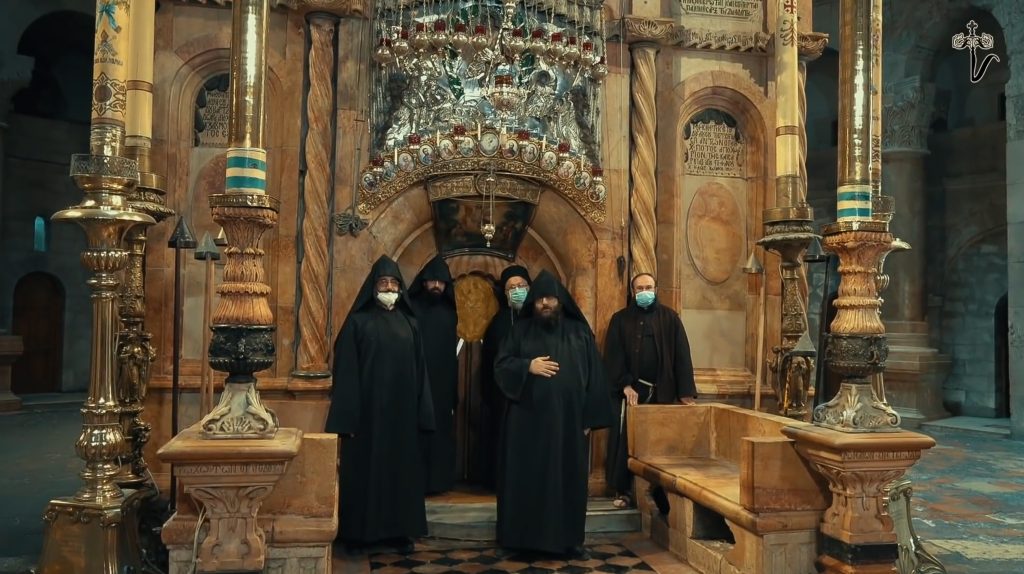
As viewers awaited the Patriarch to emerge from the Holy Sepulchre to transmit the Holy Fire, and at the moment this happened, we all saw that nothing supernatural occurred. Neither ‘flashes’ nor ‘lightning’ nor ‘luminous spheres.’ Nothing.
Even Archimandrite Antonios Stylianakis, who in a video he shot in 1994, claimed to see ‘flashes and lightning’ and a ‘luminous sphere passing over people’s heads’—a claim that, as we will see, was debunked by both the sacristan of the Holy Sepulchre, Archbishop Isidoros, and my research team—in 2020 awkwardly watched the footage as he saw no ‘spectacular things.’ His inability to explain the easily explainable, or to explain it in the way you will hear, is the definition of religious fanaticism.
This was the first ‘gift’ of that day. As there were no people inside the Church, we all saw that nothing supernatural happened. In fact, the monks of the Church were not inclined to even open the dome window to let in the sun’s rays when the patriarch emerged, as they do every year to create the impression that supernatural phenomena are occurring in the church.
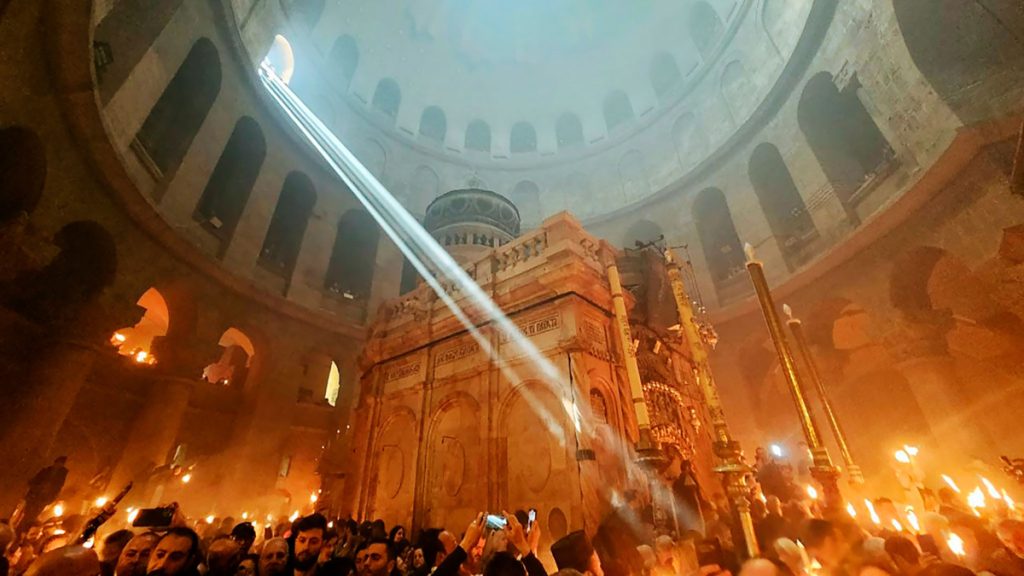
The second ‘gift’ preceded it and, arguably, was more significant than the first. Millions of faithful saw the most important part of the ceremony, which concerns the investigation, namely the ritual of the sacristan of the Holy Sepulchre entering with the lamp.
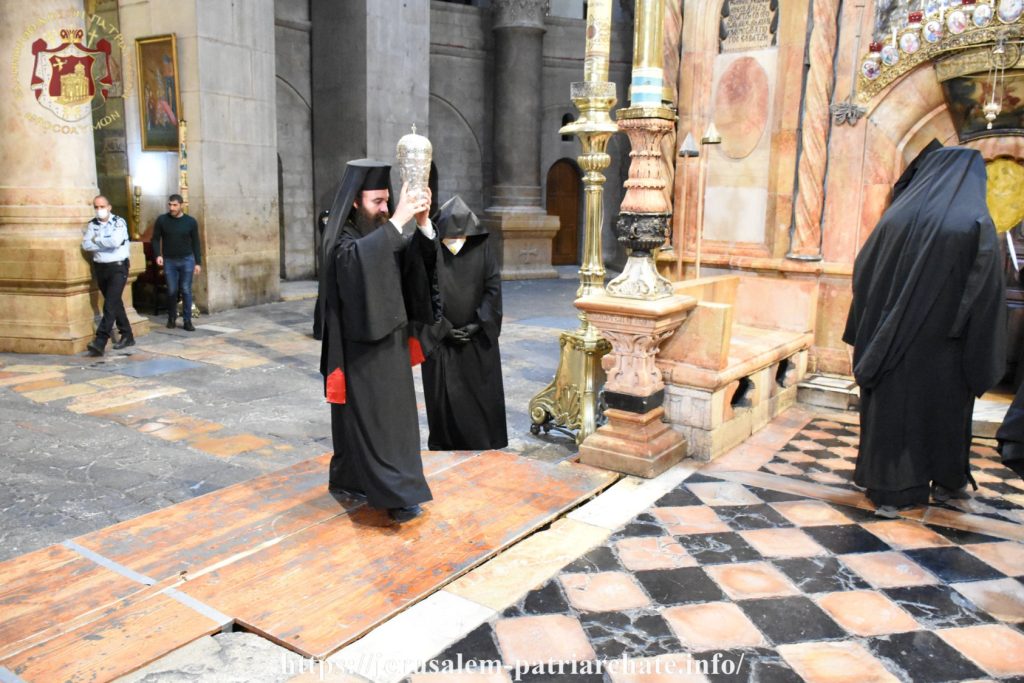
In short, millions of faithful saw the ceremony ‘naked,’ without the emotional charge of human presence, a fact that helped many accept the truth revealed by Isidoros, both about how the Holy Fire is lit and about the absence of ‘flashes,’ ‘lightning,’ and lamps that ‘light themselves.’
Why has the secret not been leaked for so many centuries?
One of the reasons, as we said, that the sacristan goes unnoticed is the crowd of people inside the Church of the Resurrection on that day.
And how is it possible that the secret has not been leaked for so many centuries? This particular question is logical and interesting to investigate. In summary, we could say the following: A clergyman who has been in the Holy Shrines since his early adolescence does not have the same understanding of the words ‘lie’ and ‘deception’ as a layman, especially a rationalist, who uses these terms. For some, yes, it is a ‘burden’ they want to shake off. For most members of the Brotherhood of the Holy Sepulchre, however, it is a ‘tradition,’ or rather a ‘myth’ that must endure as long as possible, because this strengthens the faith of ordinary people and, of course, solidifies the dominance of their presence there, especially that of the current Greek Orthodox patriarch. A distorted perception? Irrational? Perhaps. But this is also one of the reasons why the secret has not been leaked for so many centuries.
The same perception permeates a large part of other forms of power. From politics to the media, as we mentioned at the beginning. I am almost certain that a few decades ago, finding and documenting the truth would have been even easier, as people were far less distrustful and suspicious of journalists or researchers, cameras, and tape recorders than they are today. But no one ever attempted such an investigation, and if they did, they did not make it public.
The last factor —not less significant— affecting the clergy’s silence is a large segment of the “faithful.” Archbishop Cornelius’s words are revealing: “They don’t want the truth! This type of believer does not want the truth.” Here, we enter the… highly sensitive ground. That is, the issue touches the very foundation. One of its “flaws” is this: many believers insist that Cornelius (the hierarch who brought it out of the Tomb), who went to Jerusalem at 13 and stayed there until the end of his life, does not know how the Holy Fire emerges, while those who visited once for 4-5 days do. In other words, we are dealing with the absurdity of a patient insisting they know more than the doctor, and a builder more than the civil engineer.
However, regarding the Holy Fire, the situation moves beyond the comical and becomes dramatic. The Holy Sepulchre Brotherhood, beyond their own rigidities, are afraid, as we have seen. It would not be an exaggeration to say that some fear the wave of ignorance and fanaticism from the faithful when the latter are confronted with the truth. Let us recall Theotokis’s words again: “no one dares to speak against him, fearing some terrible suffering,” and those of the Metropolitan of Bethlehem to Porphyrios: “they will tear us to pieces in front of the very Chapel of the Holy Sepulchre.”
Archbishop Aristarchus’s words (“things should have been done differently long ago. Now it’s too late”) constitute an honest conclusion, but also a bitter realization of resignation. Knowing the elder closely, I dare say that every word he spoke to me had the character of an apology and contrition: “I cannot bear this burden.”
With the lawsuits and complaints against me, he did exactly that and more. Not only did he refuse to bear the burden, but he angrily shook off the few grams of responsibility he had for Isidoros’s revelation of the truth.
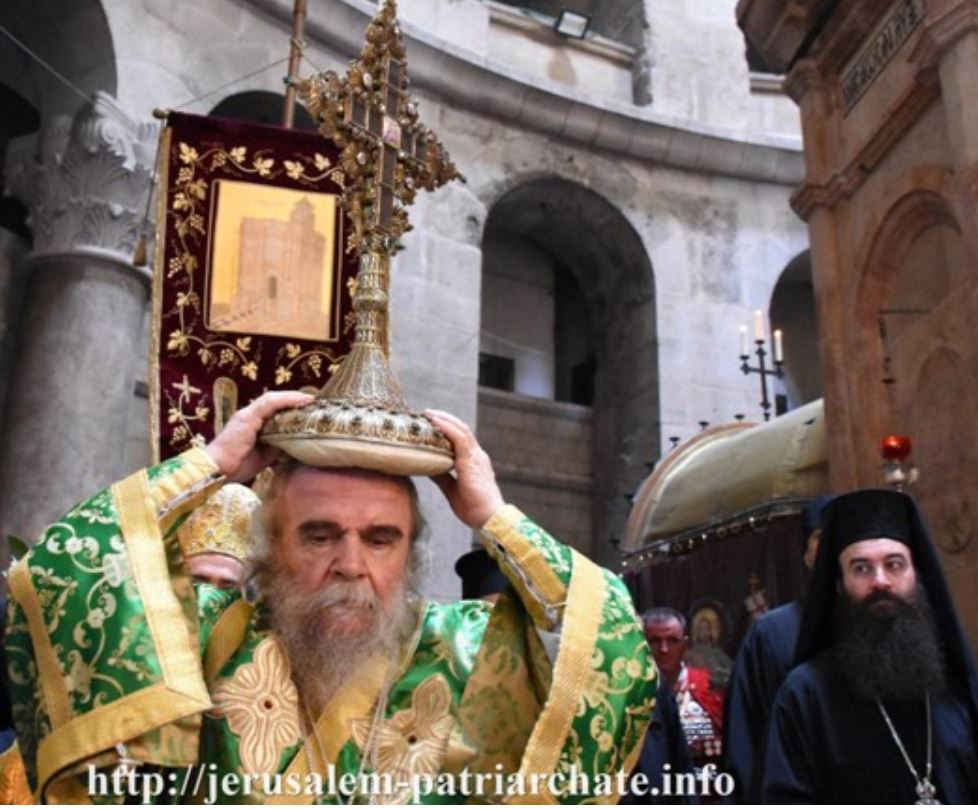
However, I believe that those who invoke the “wrath of the faithful” as an argument for protecting the secret and perpetuating the falsehood are exaggerating —perhaps it is also a convenient alibi. Experience has shown, in numerous cases, that the deceived remain silent as they are unable to accept that they were gullible and naive.
Finally, I judge that the non-disclosure of the secret should also be sought not so much in its robust protection by the Holy Sepulchre Brotherhood, but in the inability of ‘enlighteners’ and ‘progressives’ to practically distinguish between faith and religious fanaticism. That is, by combating the latter at its root and source, wherever it appears. We will inevitably be led to bitter conclusions that touch upon the contradictions and malformations of the modern Greek formation, which I do not wish to address, as they are extraneous to the present investigation and, moreover, I do not feel qualified.
Based on the above, and without any false modesty, I do not feel that in my quest I had any particular research virtues as my ally. What I will not shy away from admitting, however, is that I held a persistent belief that all ‘unexplained’ phenomena can be explained. And what cannot be explained today, can be tomorrow. And for what fails ‘tomorrow,’ it is man’s duty to persevere again and again, with the ‘weapons’ of observation, experimentation, and documentation.
What Did the Courts Rule?
The central allegation made in the criminal complaints and civil lawsuits filed by the Chief Secretary of the Patriarchate of Jerusalem and the Sacristan of the Holy Sepulchre was that I had distorted their testimony and attributed to them statements they had never made, thereby—according to them—defaming them and damaging the reputation of the Patriarchate.
The final court rulings of 2024 and 2026 rejected this allegation and reached two distinct but complementary conclusions:
- The 2024 court rulings found that I had accurately reported the statements made by members of the Brotherhood of the Holy Sepulchre. With regard specifically to Isidoros’s historic testimony—which lay at the heart of the legal dispute—the criminal court found it established that Isidoros had admitted that “the lamp […] is lit by him by natural means, namely with a lighter.” The court also found that his testimony had been recorded with his consent.
- Ruling no. 2611/2026 of the Athens Single-Member Court of First Instance, concerning the lawsuit filed by Aristarchos, went one decisive step further. It did not confine itself to determining whether I had accurately reported what I had been told. After examining the evidence in detail, the court dismissed the lawsuit and found that the statements in my book “are based on the true fact that the Holy Fire is lit through human intervention […] namely with a lighter or matches.”
The distinction is crucial. In 2024, the courts found that I had not distorted Isidoros’s testimony; on the contrary, I had accurately recorded what he revealed to me about the lighting of the lamp. In 2026, the court addressed the substance of the matter and found that the lighting of the Holy Fire is the result of human intervention. The court rulings of both 2024 and 2026 are final.
The courts were not, of course, called upon to rule on matters of faith or to assess the theological meaning of the ceremony. They ruled on something specific and factually verifiable: the manner in which the flame is lit. On that point, the court’s finding is clear: the flame does not appear supernaturally but “is lit through human intervention.”
Those who continue to maintain that the lighting of the flame itself occurs supernaturally are therefore left with only one line of defence—a paper-thin one, as we shall see: they must disregard the final court rulings of 2024 and 2026 while simultaneously portraying Isidoros as unreliable.
That position, however, is not merely an expression of doubt about his testimony. It levels an extremely serious accusation against him: it presupposes that the long-serving Sacristan and Abbot of the Holy Sepulchre falsely stated that he lights the lamp himself with a lighter and that, through a false admission, he cast doubt on the so-called “miracle of miracles.”
But did Isidoros lie?
Let us overlook the fact that he had no reason to lie, and let us assume he did. On such an important matter, with an 11-century history, for which tens of thousands of people from all over the world flock to Jerusalem every year, what would have been the reasonable reaction of the Patriarch and the Holy Sepulchre Brotherhood itself?
It is more than certain that if Isidoros had disputed the “miracle of miracles” with falsehoods, he would not have been able to remain in Jerusalem. Before the Patriarch could act, the Brotherhood of the Holy Sepulchre themselves would have shown him the door (as they did —for another reason— with Patriarch Irenaios).
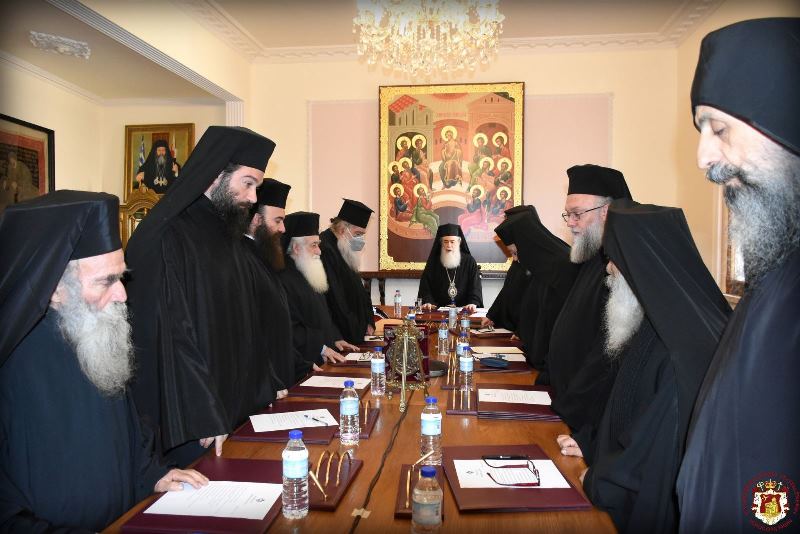
However, the exact opposite happened here. Not only did he suffer no repercussions —he remained Sacristan and Abbot of the Holy Sepulchre— but “the Holy and Sacred Synod of the Patriarchate of Jerusalem under the Presidency of His Beatitude our Father and Patriarch of Jerusalem, Theophilos”:
A. on 2019-09-25 “Appointed as Vice-President of the Ecclesiastical Court of First Instance the Most Reverend Archbishop of Hierapolis, Isidoros” (here is the decision), and
B. on 2020-09-07 “Appointed the Elder Sacristan of the Holy Sepulchre, the Most Reverend Archbishop of Hierapolis, Isidoros, as a member of the Holy and Sacred Synod” (here is the decision)
The two aforementioned events —and especially his appointment to the Holy Synod, approximately one and a half years after his testimony was made public— combined with his retention of the highly honorable position of Sacristan and Abbot of the Holy Sepulchre, attest and confirm that no proceedings were initiated against him. Therefore, he told the truth!
Exactly the same truth that the blessed Metropolitan Cornelius and Archbishop Theophanes spoke, and no one harmed them. Indeed, as we saw, Theophanes even went so far as to give sworn testimony that no miracle exists. No one dared to harm him. The reason is simple, and I will repeat it: because everyone knew the truth.
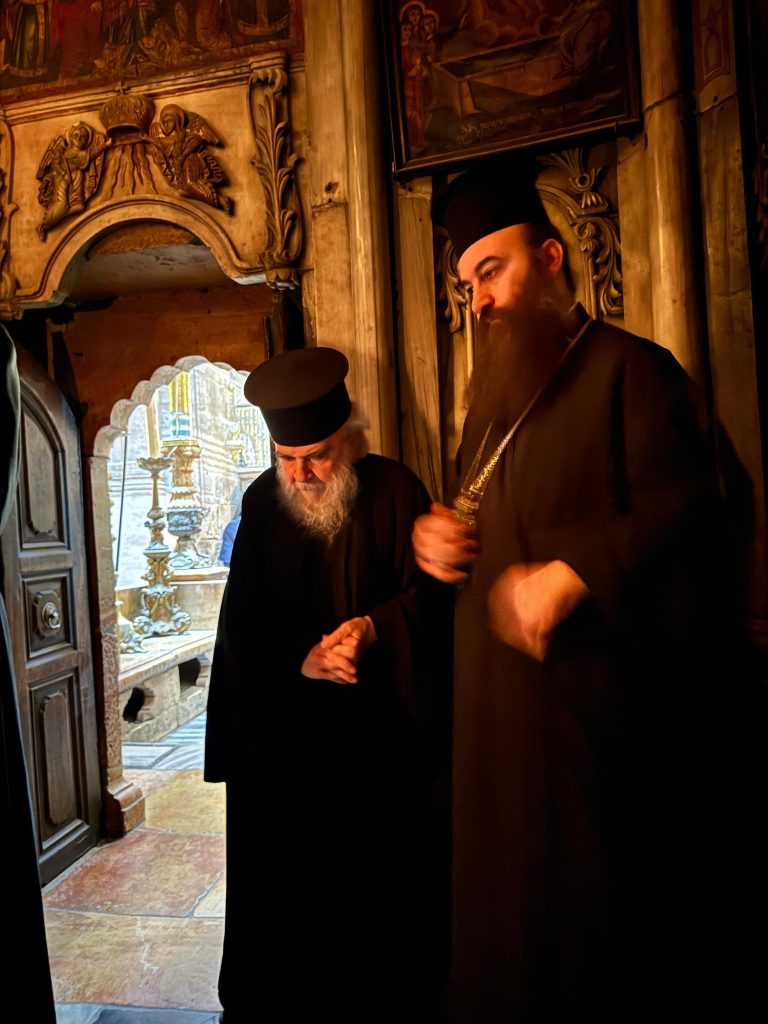
However, it must be noted here that both his retention of the position and, primarily, his appointment to the Holy Synod should not be interpreted as a reward for what he did. As I know very well, this was the result of Aristarchos’s pressure on the Patriarch to psychologically support his spiritual son, as two members of the Holy Sepulchre Brotherhood confess in their testimony, at that time “he was in a bad psychological state… he had withdrawn into himself,” and they explain the reason.
Yes, everything indicates that Isidoros was terrified. On the other hand, Aristarchus was enraged. The attitude of the former had been predicted by Archbishop Nikephoros Theotokis with the words “fearing to suffer something terrible.”
The Historical Significance of Aristarchos’s Testimony
In the criminal trial, beyond my unanimous acquittal from all charges, the testimony of the Chief Secretary of the Patriarchate constitutes a historical document. In it, although “fortified” (his own word) behind the claim of “confession,” which he invoked to avoid revealing our conversations —and especially what he himself revealed to me— at two points in his testimony he “broke” and admitted that no miracle exists as the common believer perceives it.
At the first point, he likened the Holy Fire ceremony to the ceremony of the Sanctification of Water and the Holy Unction. He said: “When, for example, we say the ceremony of the Holy Unction, will you tell me it’s a miracle? I will tell you, the miracle is included within the ceremony, what will you tell me about that? When we say the ceremony of the Sanctification of Water, the Minor Sanctification or the Great Sanctification, and you ask me if it’s a miracle? Well, what will I answer to that, the word ceremony says it all and we don’t need to investigate.”
To his statement, which concluded with a question, “the miracle is included within the ceremony; what will you tell me about that?”, the answer is easy, and of course, he knew it better than anyone else in the courtroom. The blessing of waters, for example, is a matter of faith. Whether you believe they are sanctified (a miracle in theological terms) or not, the water is there. The same applies to the olive oil in Holy Unction. The same applies to the bread and wine in the Divine Liturgy. None of these fall from the sky.
The second point of the testimony is even more revealing. To the most crucial question, regarding how the Holy Fire is lit, “Can you confirm with your hand on the Gospel that this is a miracle?” he could have answered with a resounding “YES,” potentially putting the defense in a difficult position. However, he did not. Instead, he replied:
“It depends on how we define a miracle. As a member of the Holy Sepulchre Brotherhood who has lived there for 60 years, I see the miracle… Where do I see it? I see it in the thousands of people who crowd there, in the thousands of people who await with anticipation, faith, and joy in the hope that the reception of the Holy Fire gives them.”
To the most important question, which is on the lips of millions of people seeking the truth, he answered that, yes, he sees a miracle, but where? “In the thousands of people who crowd there.”
With this answer, he unintentionally became another Isidoros. And indeed, he became the first member of the Holy Sepulchre Brotherhood who, in a courtroom, essentially publicly disavowed the miracle of the Holy Fire’s lighting.
After the historical testimonies of Isidoros, Cornelius, Theophanes, and Nikephoros, another recorded denial of the miracle was unexpectedly added. This time, from Isidoros’s spiritual father.
Epilogue: What the Research Reveals
Justice ruled that in my book I accurately recorded everything Isidoros told me. At the same time, as we saw, the court decision on Aristarchus’s lawsuit ruled, after “thoroughly reviewing the evidence,” that the lighting of the Holy Fire in Jerusalem “is proven to be the result of human intervention.”
With its stance and decisions, the Holy Synod of the Patriarchate of Jerusalem, on the one hand, protected Isidoros, and on the other hand, some tried to harm me for accurately conveying his words.
I found the answer to this paradox in the angry words of the Guardian of the Holy Sepulchre, Monk Chrysanthos, when I visited Jerusalem after the book’s publication: “What you did, to reveal the secret, was not your business. It was ours.”
I did not answer him. A few months later, I learned something I did not know: that in the works of foreign historians, the “miracle of the Holy Fire” is referred to as Greek fraud (Greek fraud), and elsewhere as “perhaps the most offensive fraud in the world.”
Now I would answer him:
Yes, it was our job, we Greeks, to restore the truth.
And at the same time, to apologize for deceiving so many faithful for so many centuries.

END