
First mission to Jerusalem
First objective: To locate the “unsleeping oil lamp”
I arrived in Jerusalem on Monday, July 2, 2018. I stayed at the historic ‘Imperial’ hotel1, in the heart of the Old City, just a two-minute walk from the Greek Orthodox Patriarchate. It was approximately 2 PM. Archbishop Aristarchos knew my arrival time, so I did not inform him immediately upon my arrival. I did not wish to disturb him during midday. “Settle into the hotel, rest, and we will meet in the afternoon,” he had told me on the phone. And so it happened.
He called me himself two hours later, and after asking if everything had gone well with the trip and the hotel, he asked what I wanted to do first:
“Do you wish to go to the Church of the Resurrection so I can ask the Sacristan to give you a tour, or come to the Patriarchate?”
“The first”, I replied.
He laughed. “Very well, I will telephone the Sacristan to ask what time he can receive you and I will call you back”.
Five minutes later, he informed me that the ‘Elder Sacristan, Archbishop Isidoros of Hierapolis, is currently at the Church and is waiting for you. I told him you are a journalist”.
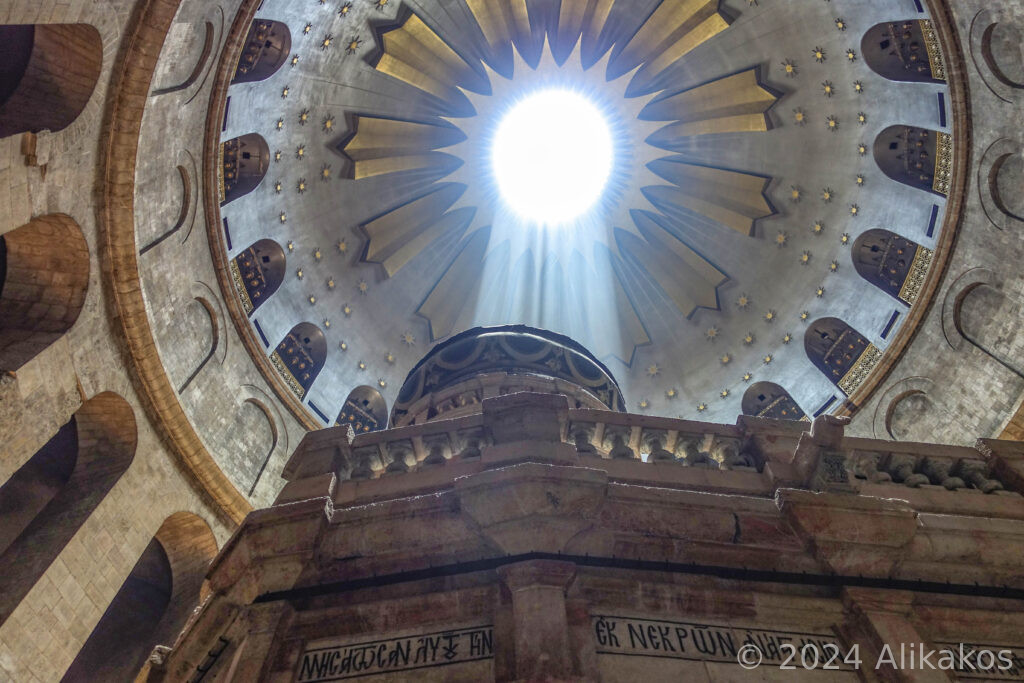
Isidoros, who “in 2005 was appointed Assistant Sacristan and in 2013 Elder Sacristan of the Holy Sepulchre”, as stated in his official biography, was waiting for me a few meters from the entrance of the church.
The tour began with a standard description of the ceremony prior to the lighting of the Holy Fire.
Most of the details were known and are documented extensively in various ecclesiastical sources. However, some other points were of interest.
“I place the lamp inside the All-Holy Tomb”
For example, it is widely believed that only two people enter the Holy Edicule of the All-Holy Tomb: the Greek Orthodox Patriarch and the Armenian Patriarch.
However, there are two errors in this belief. First, it is not the Armenian Patriarch who enters together with the Greek Orthodox Patriarch, but an ordinary priest.
The Armenian Patriarch, at the time of the ceremony, is located on the balcony, to the left of the church; there, when the Holy Fire “comes out” through the left aperture from the hands of the priest, an Armenian runs and delivers it to him.
Many believers see the Armenian’s candle moving, without however seeing the man himself, and form the impression that, before the Patriarch emerges to transmit the Light from the main Gate, it appears miraculously on the balcony.
Yes, it appears, but it is anything but a miracle.
The second, more significant misconception concerns the number of people present inside the Holy Edicule when the Holy Fire is lit: there are three, not two. The Greek Patriarch has already entered the All-Holy Tomb, while the Armenian priest and the commander of the Israeli police in the Old City stand in the antechamber. Here is Isidoros’s explanation:
“This began to be implemented under Patriarch Theophilos, because there were times when the Armenian priest had attempted to enter the space of the Tomb to pray alongside our own Patriarch.
Verbal altercations had occurred, and perhaps even the use of physical violence.
In fact, in 2002, under Irenaios, the Armenian priest attempted to enter the All-Holy Tomb so that they might receive the Holy Fire together. Irenaios did not permit him, and then the Armenian took out a lighter and lit his candles.
Then Irenaios grabbed them from his hands and threw them to the ground.
All this was heard outside, and our people entered with the police and attempted to stop the commotion. Thus, the Patriarchate was compelled to request the assistance of the Police at the highest level.
Since then, things have calmed down, and the Armenian priest stands outside the All-Holy Tomb—that is, in the antechamber—and waits for the Patriarch to emerge”
The presence of the Police Chief is also confirmed by the footage of the ceremony broadcast by the media every year. He can be seen behind the Patriarch and the Armenian priest.
Of course, although we can see him emerging, in no video—except for that of the 2020 Ceremony, where the church was empty due to the pandemic—was I able to see him entering.
‘This is done discreetly, when the lights go out,’ Isidoros explained to me.
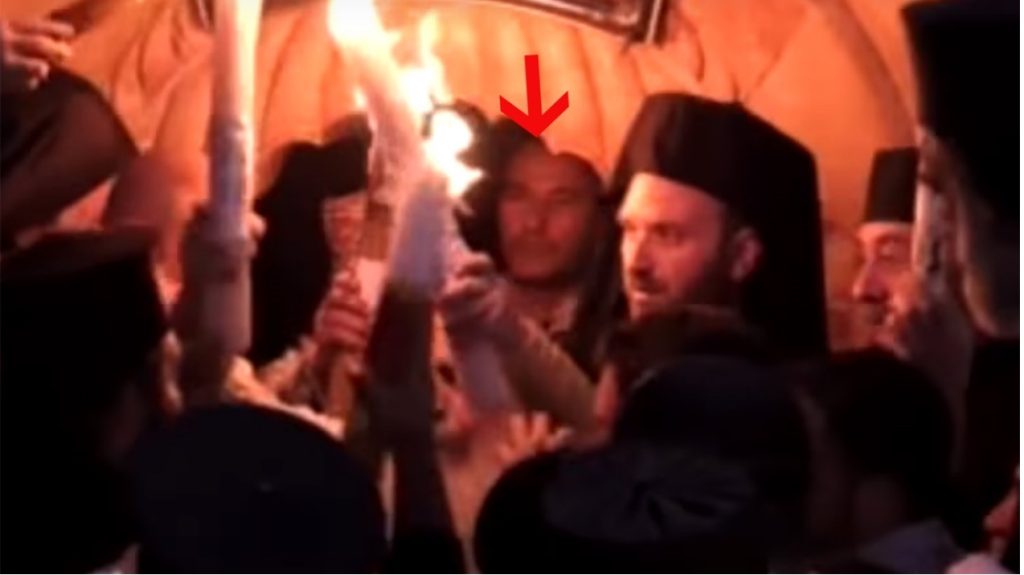
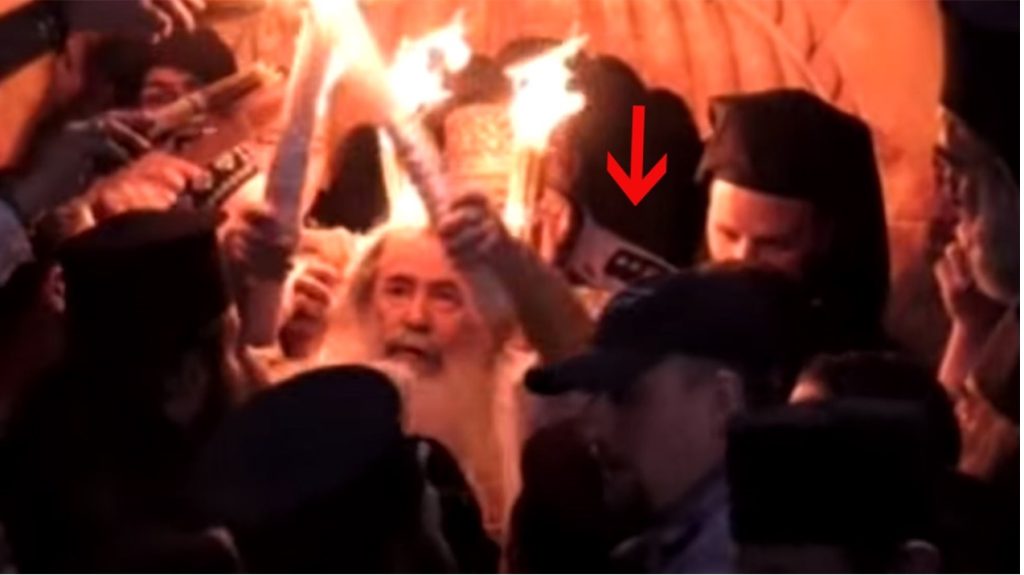
Continuing this valuable tour, we proceeded to the area of the Holy Edicule, inside which the All-Holy Tomb is located.
Seeing Isidoros, the Hagiotaphite guard stopped the flow of pilgrims—there were hundreds of them—so that we could enter.
In the antechamber (the area of the Holy Stone), he showed me the spot where the Armenian priest stands: to the left after the entrance, above the Holy Stone, near the aperture from which he passes the Light to the Armenians at the end of the ceremony.
On the opposite side stands the police officer, next to the aperture from which the Patriarch gives the Light to the Orthodox Arabs, before emerging to distribute it from the main Gate.
Next came the All-Holy Tomb. The emotion was intense, but controlled. I was there for a single, unique reason: to learn what happens on Holy Saturday, right in this very space.
I bent down and venerated the Tomb with awe and respect.
When I stood up, I asked the first critical question: “And where do you place the oli lamp?”
He reached out his hand and showed me: “Exactly at this spot, in the center of the Tomb”.
I captured the image.

But before that, he told me something else as well:
“Before I enter, on the morning of Holy Saturday, the guards of the All-Holy Tomb enter and place their own extinguished lamp in this space”.
It was the first time I was hearing such a thing. No matter how much I searched later in various sources, I found no relevant reference.
“So there are two lamps, Your Eminence! The one extinguished. The other?”
I was sure that the answer would be the same as that of Chief Secretary Aristarchos.
I was wrong.
“This one is extinguished too”
A few words about the oil lamp
In more recent2 ecclesiastical texts, it is referred to as an “Unsleeping Lamp” or “lychnia” or simply “kandili”. It is described as “unsleeping” because its flame never goes out. In Orthodox churches, the “Unsleeping Lamp” burns above the Holy Altar, in front of the Crucifix. Every Holy Saturday, in all churches, for centuries now, the priest lights his candle from it. Immediately thereafter, the “Come, receive the Light” follows.
The entry of a lamp into the Holy Sepulchre, prior to the Holy Fire ceremony, is not disputed. Beyond the fact that the Patriarchate itself admits its existence, as we will see below, (it is even mentioned in The Status Quo in the Holy Places, p. 68, year 1929) it enters in front of everyone, and in recent years, with the help of the internet, everyone has access to this image. Everyone can see the lamp entering the Holy Sepulchre, approximately 45 minutes before the ceremony, carried by the sacristan. Indeed, before entering the Holy Sepulchre to place the oil lamp on the burial slab, the sacristan stands motionless for a few minutes in front of the Holy Edicule.
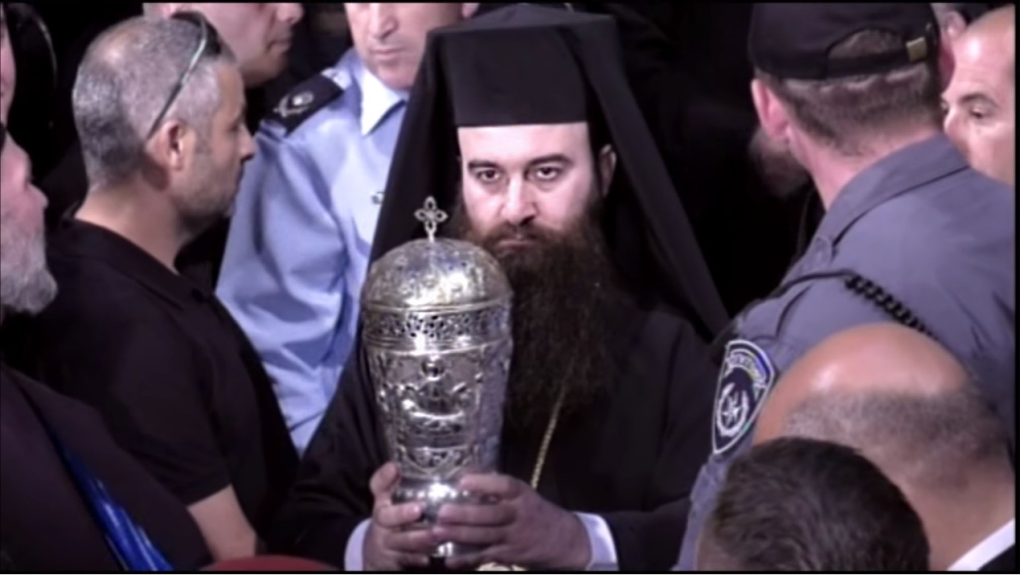
Therefore, if the lamp enters the Holy Sepulchre, it enters for a reason, to fulfill a “mission,” because “it is used in the sacred ceremony”3. Otherwise, this entire ritual of its entry into the Holy space makes no sense. If it enters lit (let’s set aside the other lamp that arose from discussions—that of the guards—its turn will come), many—perhaps all—things are explained. But if it enters unlit, what is the reason for its entry? And secondly, how will the Patriarch light his candles from an unlit lamp? And why did Aristarchos (one of the oldest Hagiotaphites) assure me that “it enters lit”?
- The hotel became the center of the scandal that led to the deposition of Patriarch Irenaios in 2005, as he was accused of conceding it to Jewish interests. ↩︎
- The first reference to it as an “oil lamp” appears in Kallistos Miliaras’s Historical Study Concerning the Holy Fire (1934), p. 27. ↩︎
- A phrase from an earlier official text published online by the Patriarchate, specifically in the “Holy Fire” section. The passage also appears in K. Miliaras’s study (p. 27). A little further on, the author continues: “Our Sacristan enters alone, carrying the sacred lamp, which he places on the Holy Sepulchre.” It should be noted that the word “alone” had been removed from the earlier text in the relevant section of the Patriarchate’s website. https://web.archive.org/web/20130102073323/http://www.jerusalem-patriarchate.info/gr/agion_fos.htm ↩︎