
Meeting with the Patriarch
“Only five minutes”
On the morning of July 3rd, I made my way up to the Patriarchate. I entered the Chief Secretariat and then Aristarchos’s office. He was engrossed in stacks of papers. “Please sit, I’ll be done shortly.” I remained silent, observing his office. I immediately understood why, during our first communication, he didn’t know what the Patriarchate’s website stated about the Holy Fire: because he didn’t have a computer. And not only that. As I realized, the person in charge of the Patriarchate’s website had minimal knowledge of computers and the internet. Without any intention of criticism (neither then nor now), I told him, smiling. He also laughed: “I’m old, I’m not good at these things. Fortunately, the girls are here to help me.” He was referring to the nuns and the employees.
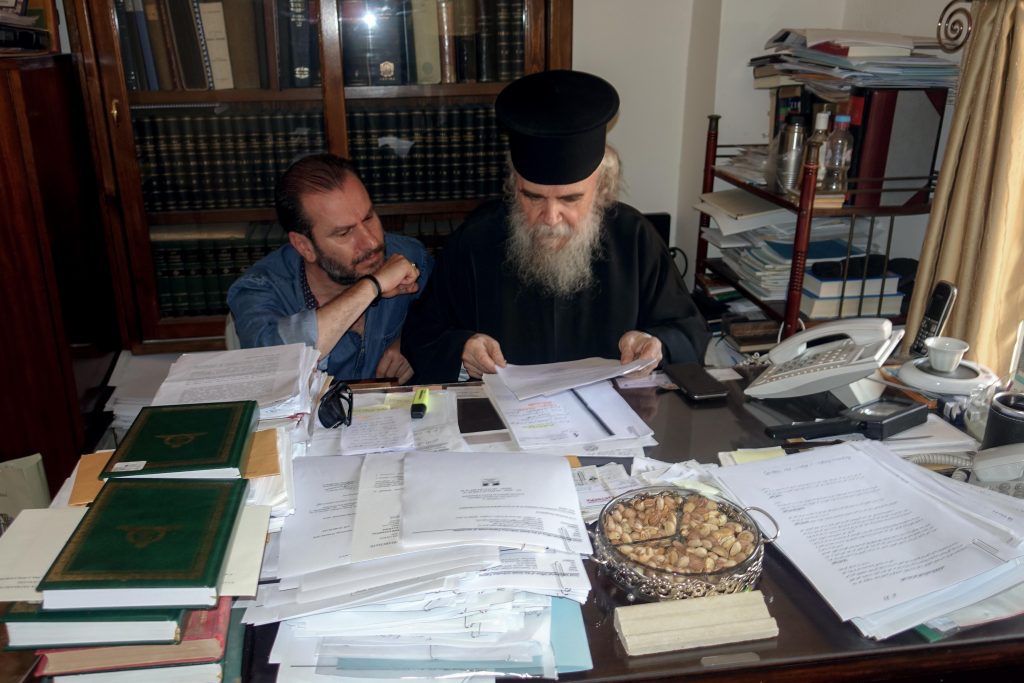
I didn’t tell him anything about what happened with Isidoros. I didn’t want to put him in a difficult position, and, most importantly, I hadn’t completed my research. More accurately, I was, for the time being, at a dead end. Aristarchos, throughout this period of repeated phone calls, treated me with abundant kindness and understanding. He could have avoided me. He didn’t. On the contrary, although he warned me about “certain things” I would encounter at the Patriarchate, and although he wasn’t enthusiastic about my arrival there, I never sensed any suspicion in his voice or gaze. He perfectly balanced what he wanted with what he could do.
“I suggest you see the Patriarch today. He has a packed schedule, but perhaps we can find a slot for him to see you. What do you say?” “Absolutely!” “Alright. As you know, I’ve spoken to him about you, and he’s aware that you’re here and why. Soon he has a meeting with pilgrims in the great hall. You should also go and attend the event – I’ll be there too – and as soon as it’s over, I’ll inform him so he can see you. I can’t promise he’ll be able to see you, but we’ll see…”
I did exactly as he told me. I went to the event hall. The place was full of pilgrims. Soon, Patriarch Theophilos arrived. Speeches, courtesies, psalms, distribution of souvenirs to the pilgrims… All of this must have lasted over an hour, including a group of Russians who arrived at the end. When Theophilos began giving a souvenir to each pilgrim, I stood last in line. I took a small icon, kissed his hand, and told him: “I am the journalist from Athens they told you about, and I would like you to spare five minutes to talk about the Holy Fire.” He looked exhausted. Furthermore, it’s certain that he didn’t expect the last… pilgrim to request a meeting about such a pressing issue. His reply – in a relatively stern tone – brought me abruptly back to reality: “No, no… I cannot today.”
I immediately went to find Aristarchos and tell him the news. “Go and sit outside his office. He also has a few other meetings with some people. Although he is tired, I believe we will find a slot before he retires to his room.”
I went and sat on a sofa outside his office. And I waited. People came and went. Laypeople and clergy. At one point, I saw a Holy Sepulchre Brotherhood member – unknown to me – coming out of his office and, as he quickly passed by me, he whispered: “Patience, we will succeed.” Who was this? I didn’t know. Later, of course, I understood. It was Archdeacon Father Markos from the Patriarch’s Private Office. Another good person who did everything he could to make this meeting happen. And so it did.
A little later, Aristarchos appeared and almost ordered me: “Go in now! Only five minutes”
This was perhaps the wish of the Patriarch, and perhaps of Aristarchos, and perhaps of Father Markos. I don’t know, but my own wish – regardless of what I told him in the hall – was different. Five minutes were not enough to ask him all the questions I had in mind.
Ultimately, our meeting lasted about thirty minutes.
“Nobody searches the Patriarch” – “There is no miracle”
I knew I had very little time at my disposal. Furthermore, I knew I would be opening a discussion that the Patriarchate avoids when the question of “how” is posed. On the one hand, I had to avoid any question that the Patriarch might perceive as offensive, which could potentially make me feel unwelcome. On the other hand, however, I was determined to raise all issues concerning the Holy Fire. I was almost certain I wouldn’t get a second chance. Therefore, I had to be careful not about what to say, but primarily how to say it.
It began with a book I gave him as a gift. He showed interest and started asking me about it. Then he asked me about my studies and my family background. He was impressed when I told him that my father is a priest and that I had also attended a seminary (Rizareios). Minutes passed, and I somehow had to make a start. And so it happened: “You know, I have some questions about the Holy Fire ceremony, and I would like you to help me resolve them.” “Of course, I’m listening.” I opened my bag and took out my small video camera, ready to press record.
He reacted: “No, I would not like that.” “Understood. First, I would like to ask you if, when you enter the Holy Sepulchre on Holy Saturday to receive the Holy Fire, anyone searches you. I have read this in various religious texts. Is it true?” “No, it’s not true. Nobody searches the Patriarch.” That myth is gone, I thought to myself. “It has also been written that before you enter the Holy Sepulchre, it is thoroughly searched by representatives of other denominations. Is that true?” “No, that’s not true either.” That myth is also gone.
Of course, I avoided telling the Patriarch that these two claims had been posted until recently on the official website of the Patriarchate. I left the website issue to raise it along with the main point:
– I recently noticed that you changed the text about the Holy Fire ceremony on the Patriarchate’s website, and another text was put in its place, which nowhere mentions a “miracle.”
– Yes, that text should not have been there; I don’t know how it got there.
– Yes, but the new text does not speak of a miracle.
– But the Patriarchate does not speak of a miracle! The Greek word for miracle, “thavma”, comes from “thavmazo” (to wonder/admire). What connection could it have with a sacred ceremony?
I couldn’t believe my ears. Inevitably, the next question could be none other than the so-called “forbidden” one: “And since it’s not a miracle, then how does the Holy Fire ignite?”
Patriarch Theophilos III’s answer to this crucial question was a long monologue, which began with the phrase, “Look, this is a personal experience that is impossible to share…”, and continued with theological analyses that had no relation to the question. I immediately understood that he wished to steer the conversation elsewhere. I tried to interrupt him: “Yes, but you know…” Nothing. An unstoppable torrent. Minutes passed. At one point, Father Markos entered the room and signaled to me with his hand, “time’s up.” I raised my voice slightly, but noticeably:
– Your Beatitude, allow me, what you are telling me is very important, but I want to ask you another question (all or nothing, I thought to myself): Is the oil lamp that enters the Holy Sepulchre lit or unlit?
– Lit, of course.
Shock!
– Lit?
– I told you, lit.
– So, that means, when you enter the Holy Sepulchre, you find a lit oil lamp in front of you. Is that what you’re telling me?
– No, I find it unlit!
I remained silent for a moment, trying to understand.
– So it enters lit, and you find it unlit? How is this possible, Your Beatitude?
I am unable to convey the Patriarch’s answer to this question, as it was completely incomprehensible to me. I only retained the words “mystery,” “inexpressible experience,” “alteration of space,” and, in the end, “there is no miracle.”
Descending the stairs of the Patriarchate, I felt that logic – not my logic – had been severely attacked. The oil lamp “enters lit,” the Patriarch finds it “unlit,” and this is a result of “alteration of space,” but “without a miracle.” None of this made sense.
Only the souvenir photo with him made some sense.
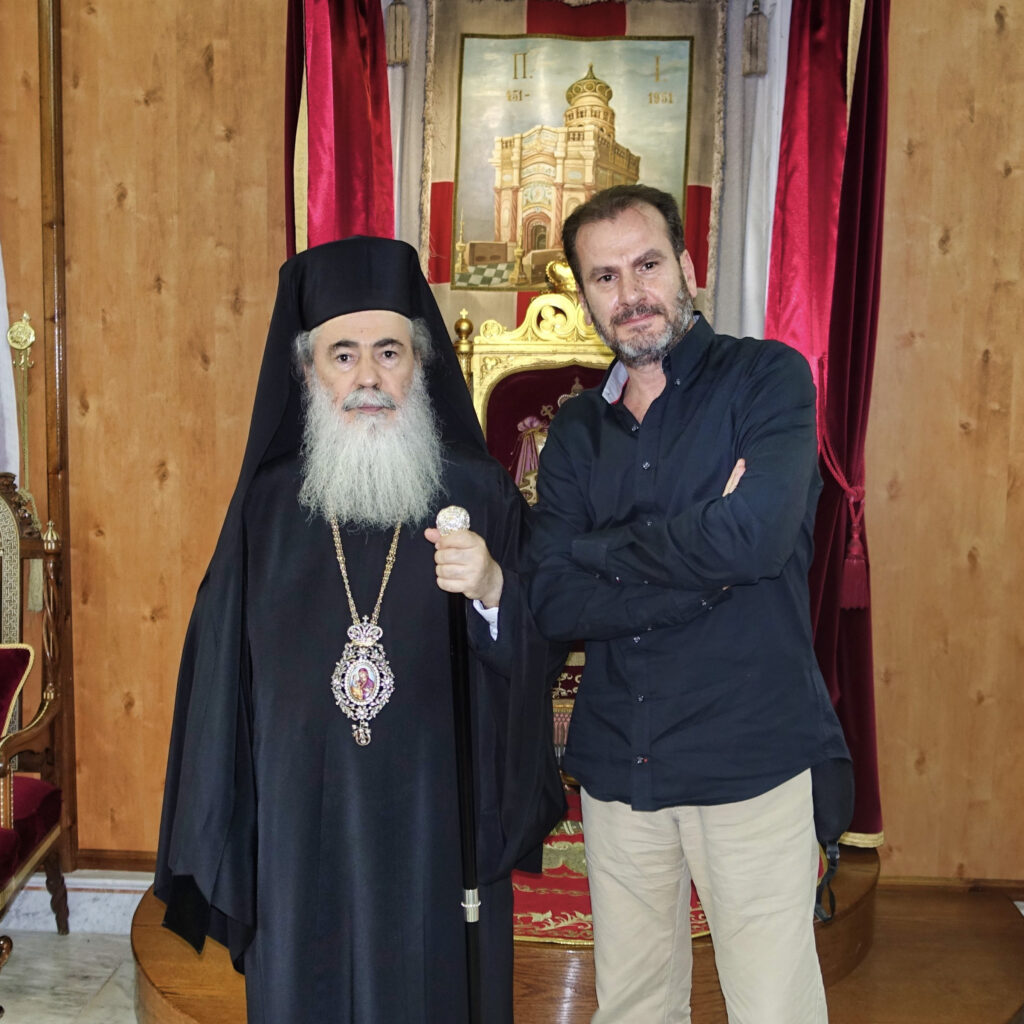
Nevertheless, the meeting had yielded significant news. The Patriarch, against all expectations, chose the provocative version of the lit oil lamp, an inflammatory claim for those who believe in the miracle, and confirmation for skeptics. Why did he do this? Did he proceed with this “revelation” in order to move closer to a rational interpretation of the phenomenon (following the change in the text about the Holy Fire on the Patriarchate’s official website)? Or was it a clever maneuver to avoid the true revelation of the truth (which, as we will see, he demonstrably knows)?
Was the admission of the lit oil lamp, combined with the statement that “there is no miracle,” essentially a smokescreen for the investigation, in order to conceal a terrible truth that no one ever suspected and has never been recorded anywhere?