Last Day in Jerusalem: “Don’t dig into it”
“I didn’t even tell my brother the secret”
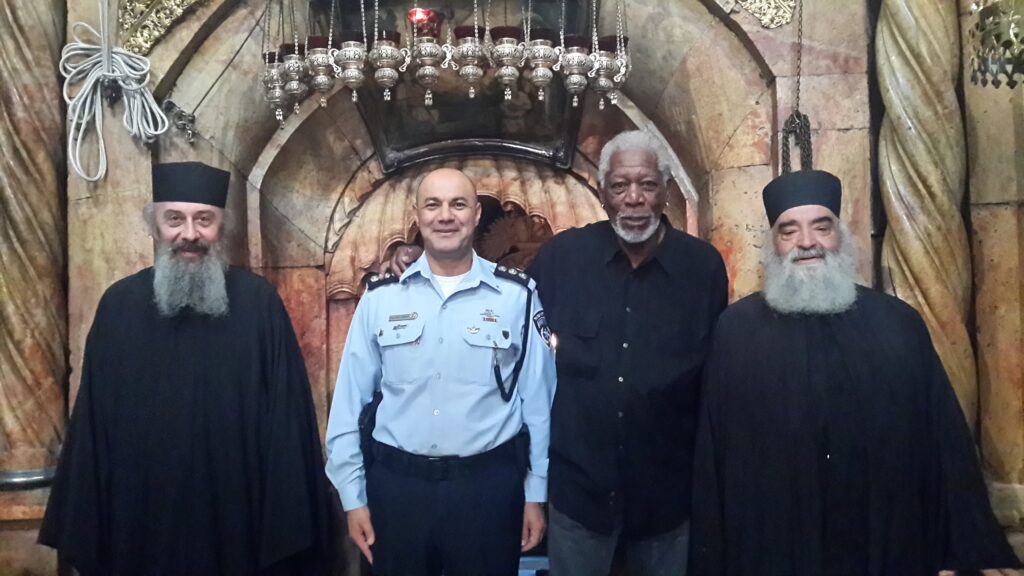
Friday, October 26, 2018, the day of my return home. I passed by the Church of the Holy Sepulchre for the last time. I went directly to the Holy Edicule. The eyes of a guardian monk immediately fell upon me. I continued walking. I headed towards the exit. Behind the Stone of Anointing, someone grabbed my arm. “Brother, one moment, I wish to speak with you.” It was the guardian who had been watching me moments before. He appeared to be in a state of near agitation.
“What Panteleimon did yesterday was a great folly…” At that moment, I remembered who he was. When I was speaking with Panteleimon about the second oil lamp, which he held in his hands, and I was filming him, someone opened the door. As soon as he saw the scene, he made a grimace of displeasure and closed it forcefully. It was him. Monk Chrysanthos.
“Leave this sensitive matter alone; this is how we found it, don’t dig into it. When I first came here, during my first Easter, an Archimandrite, Stephanos, with whom I served as a guardian, told me, ‘Come, let me tell you something,’ and he told me the secret. My brother comes here many times. Even he doesn’t know it.” “So, he asked you, and you didn’t tell him?” “Of course. He asked me, and I told him I knew nothing. When Stephanos told me, I said to him, ‘Thank you for telling me, but it’s as if you never told me.’ Listen, brother, people come for this; why should I disappoint them? I leave it as it is. Why should I take away their faith by telling them what Stephanos told me? They draw strength from it, they get well…”
I interrupted him. “One moment. If someone comes and tells you, ‘The truth will not harm my faith, but will strengthen it,’ what will you tell them?” “It will not strengthen it…” “So, does the truth cause scandal?” “Yes, yes, it causes scandal, it will create a problem. The answer to anyone who asks is, ‘I don’t know,’ and that’s it. Even if I do know.” “Since it didn’t cause you scandal when you learned the secret, why should it cause scandal to others?” “No, brother, I am an exception. I am speaking about you who learned it. I must leave now… The Lord told me after prayer to tell you: Do not continue! You will have a problem of conscience, but you will also hinder people… Go find Monk Theodoulos. He will tell you better.”
Who was Monk Theodoulos? Upon returning to Athens, I researched and learned. He was the one who caused the incident with Armenian Bishop Samuel Agoyan in March 2018. At that time, Agoyan had questioned the miracle in front of a camera of an Israeli television channel, stating that the Holy Fire is lit from the oil lamp (and he himself saw it three times, as he declared), and Theodoulos became furious, insistently demanding that the filming stop. Shortly thereafter, the Greek monk claimed that the truth is that the Light descends miraculously.
His case piqued my interest. Did Theodoulos not know the secret, and therefore spoke the truth he believed, or did he know it and say what he was supposed to say?
The answer came from the abbot of the church: “No, that particular monk does not know the truth.”1
Reaction of the Russian Church.
Following the statement by the Armenian bishop, the Moscow Patriarchate reacted strongly, declaring that “The Russian Orthodox Church has no doubt about the miraculous descent of the Holy Fire.” The press secretary of Patriarch Kirill described the Armenian’s statement as “strange” and added: “There is no question of disputing the miracle.” (source here)
It was another proof of the power of the “miracle” in a country with millions of Orthodox Christians. However, the same question arose in my mind as with Theodoulos. Do the Russian Church and the Patriarch truly know the truth, or do they believe in the miracle? This exact question I posed to Archbishop Theophanes in Jerusalem.
He replied as follows: “Of course they know the truth, just as we old Holy Sepulchre Fathers know it – they even have a representative office here, after all – but they do not tell it, supposedly, so as not to cause scandal to the faithful.”
And yet, something was missing.
Upon my return to Greece, I tried to organize my thoughts and calm myself. I had discovered something incredible – I myself could not believe it – which had been sought for centuries. The combination of testimonies (an archbishop who brought forth the Holy Fire
and a sacristan who revealed how the “miracle” is created each year, by his own hands) constituted absolute documentation. These two testimonies were supported by that of the former sacristan Nikephoros, who corroborated his successor’s account, and by the “testimony” of the oil lamp, which also “spoke”. Taken together, they constituted what is known as proof in the empirical sciences. Was there any gap? Any reason to dispute this proof? Yes, there was.
In such a significant and emotionally charged matter, which has left behind historical disputes, the slightest lack of strong evidentiary material could become a weapon in the hands of fanatics, ill-intentioned individuals, or even those who rightly demand to see with their own eyes and hear with their own ears to believe. And this lack existed: it concerned the proof that the historical testimony of Isidoros exists. In the era of digital recording, such errors are not forgiven. Furthermore, I did not have the right to allow the truth to be disputed due to my own omission. I absolutely had to revisit Jerusalem.
- Following the revelation of the truth in my book, the monk in question left Jerusalem. He went to a monastery in Greece. ↩︎